
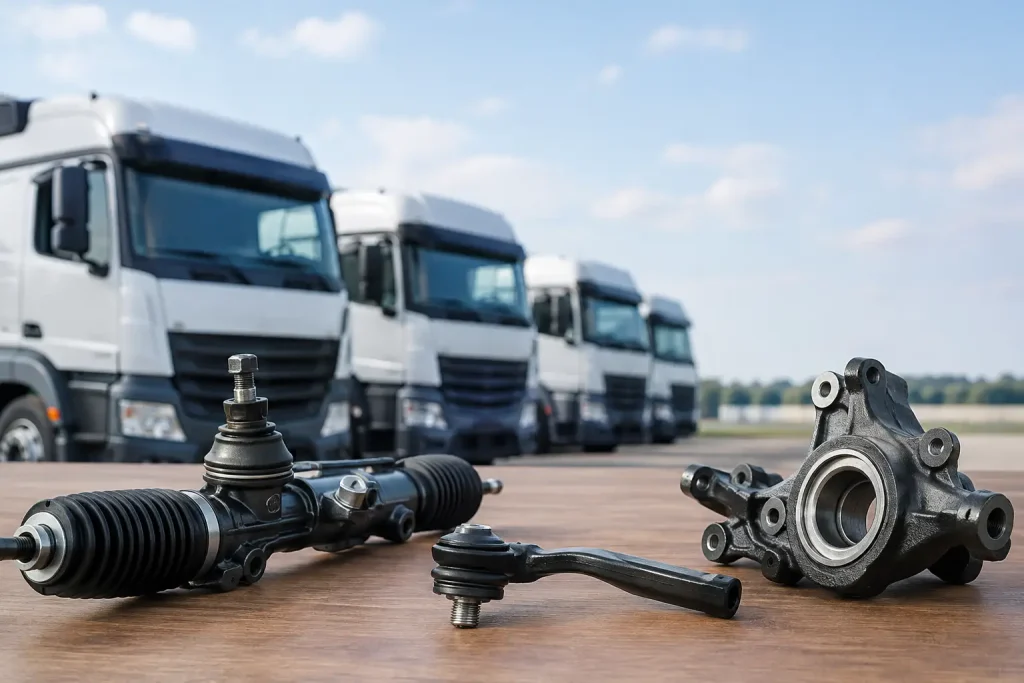
A fleet vehicle with wandering steering, an EPS warning light or a leaking rack is more than an individual workshop job. It can affect driver confidence, tyre life, vehicle availability and operating cost. Choosing between fleet steering component options starts with an accurate diagnosis, not an assumption that a complete new rack is the only safe answer.
For fleet operators, workshops and vehicle managers, the right route depends on the fault, the vehicle’s duty cycle, component availability and the work required after installation. A repairable hydraulic rack, an electronic steering rack needing programming, and a worn steering box on a commercial vehicle each call for a different decision.
Fleet steering component options: start with diagnosis
The steering system must be assessed as a system. A complaint of heavy steering or poor directional control may originate in the rack or box, but it may also relate to the column, intermediate shaft, track rods, steering geometry, electrical supply, tyre condition or suspension wear.
On vehicles with Electronic Power Steering, diagnostic fault codes are useful but should not be treated as a complete diagnosis on their own. Low voltage, wiring faults, water ingress, damaged connectors and calibration issues can all produce steering warnings. Likewise, a hydraulic fluid leak does not automatically mean the entire rack is beyond serviceable repair. The source and extent of the leak matter.
A proper assessment establishes whether the fault is internal, external, mechanical or electronic. It also identifies whether a component can be reconditioned safely, whether an exchange unit is appropriate, or whether replacement is the only sensible route. This avoids fitting parts unnecessarily and helps a fleet plan downtime with greater confidence.
Repairing the existing steering component
Component-level repair is often the most suitable option where the rack, steering box, column or shaft has a defined fault and the main assembly remains serviceable. Depending on the unit, this may involve addressing internal seals, bearings, bushes, valves, gears or worn mechanical parts using appropriate OE or OE-quality components.
The principal benefit is that the original unit is retained. This can be particularly valuable for older vehicles, specialist applications and right-hand drive systems where an exact replacement is difficult to source. It can also reduce delays associated with a new component being on back order.
There are limits. Corrosion in critical areas, badly damaged housings, excessive internal wear, impact damage or obsolete parts availability can make repair unsuitable. The decision should be based on the condition of the unit after inspection, rather than an attempt to force every component into a reconditioning process.
For fleet operators, repair is most effective when vehicles are presented before a minor concern becomes a roadside failure. A slight rack leak, increasing free play or intermittent EPS assistance gives more scope for planned workshop time than a vehicle that has already failed a safety inspection or become undriveable.
Reconditioned and exchange steering racks
A professionally reconditioned rack or steering box provides a practical middle ground between repairing the vehicle’s own unit and fitting a brand-new assembly. The original component is stripped, cleaned, inspected and rebuilt where suitable, then tested before it leaves the workshop.
This route can suit fleet vehicles where quick turnaround matters and an exchange unit is available. It is also useful when the fleet’s original rack must be removed and returned as a surcharge core. A common stock application can minimise vehicle-off-road time, provided the part number, steering configuration and electronic specification are verified first.
However, not all reconditioned units are equal, and part number matching alone may be insufficient. A rack can differ by vehicle identification number range, motor specification, sensor arrangement, software generation, steering ratio or left- and right-hand drive layout. Fitting an apparently similar unit can create faults that only become apparent during coding, calibration or road testing.
A specialist steering business such as Pro Power Steering can advise on suitable component options, assess customer units and support fitting garages with technical information where required. Completed applicable work is supported by a 12-month warranty under the relevant terms, giving fleets a clear basis for repair planning.
New replacement components
New replacement steering components remain the correct choice in some circumstances. A new unit may be necessary where the original assembly is not economically repairable, no suitable exchange unit exists, the manufacturer requires a specific current version, or the vehicle remains within a warranty arrangement that dictates the repair route.
For a large fleet, standardising on new parts can simplify procurement and warranty administration. Yet it can involve longer lead times, particularly for premium, commercial, classic or specialist vehicles. The purchase price may also be only part of the total cost once programming, calibration, wheel alignment and vehicle downtime are considered.
New does not remove the need for diagnosis. If the underlying cause was a damaged loom, low system voltage, seized steering linkage or incorrect geometry, a replacement rack may display the same symptoms or suffer premature damage. The installation should address the source of the original failure, not merely replace the failed item.
Electronic racks: coding and calibration are part of the job
Many modern fleet vehicles use EPS racks with an electric motor, torque sensor and control electronics. After fitment, the rack may need vehicle-specific coding, configuration or calibration before it operates correctly. Some systems also require steering-angle sensor calibration and a controlled road test.
Where applicable, an EPS rack may be flashed or virginised in preparation for coding to the vehicle. This is not a universal process and it does not replace the vehicle manufacturer’s required procedures. Some applications need dealer-level equipment or access to manufacturer systems, particularly where security functions or software updates are involved.
Fleets should account for this at the booking stage. A rack fitted mechanically but left uncoded is not a completed steering repair. The same principle applies to wheel alignment. Any steering-rack removal, track-rod adjustment or impact-related steering repair should be followed by an alignment check to protect tyre wear and restore predictable handling.
Steering boxes, columns and related components
Fleet steering work is not limited to racks. Many commercial vehicles, older 4x4s and classic vehicles use steering boxes, while columns and intermediate shafts can develop wear, stiffness, play or electrical faults. These parts deserve the same measured approach.
A worn steering box may be suitable for refurbishment if the casing and core internal parts are serviceable. A column issue might be mechanical, related to an ignition lock housing, or connected to an electronic locking or sensor function. Replacing the wrong section can add cost without resolving the driver’s complaint.
For restoration fleets, specialist vehicles and older vans, retaining and refurbishing an original component may preserve correct fitment and steering feel. For hard-working commercial vehicles, the priority may be dependable turnaround and a tested exchange solution. Neither approach is automatically better. The operating requirement should guide the choice.
Choosing the right route for fleet uptime
The most useful question is not simply whether repair is cheaper than replacement. It is whether the selected route restores safe, smooth and precise steering with an acceptable level of downtime and a clear understanding of follow-on work.
Consider the vehicle’s role. A delivery van that cannot miss its route, a premium chauffeur vehicle, a lorry operating under heavy load, and a low-mileage pool car have different availability pressures. Consider the fault history too. Repeated steering concerns on the same model may justify reviewing common causes, inspection intervals and parts stocking rather than treating each failure in isolation.
It is also sensible to record the original symptoms, diagnostic findings, work completed, coding status and alignment result. That information helps the fleet identify patterns, supports warranty discussions and gives the next technician a useful starting point.
The best fleet steering decision is usually the one made before a small fault turns into lost vehicle time: diagnose the system carefully, select the component route that genuinely suits the application, and make sure the repair is finished with the calibration and alignment work the vehicle requires.
