
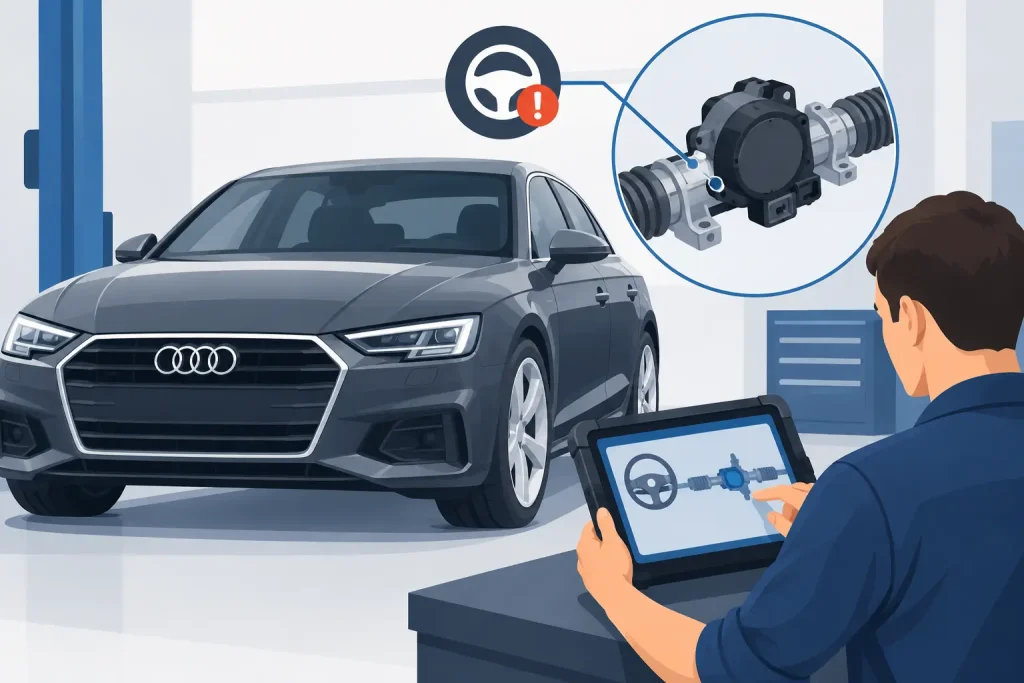
An illuminated steering warning lamp on an Audi can quickly turn from an annoyance into a safety concern, particularly if assistance becomes intermittent or the steering feels heavy. The right Audi EPS repair options depend on the exact system fitted, the stored fault information and whether the fault is electrical, mechanical or communication-related. Replacing a complete steering rack without that evidence can be expensive and may not cure the underlying issue.
Electric power steering, or EPS, is fitted across a wide range of Audi models. Depending on the vehicle, assistance may be generated by an electric motor on the steering column or by a motor integrated into the rack assembly. The system uses inputs such as steering torque, steering angle, vehicle speed and wheel position to provide light assistance at low speeds while retaining stable, progressive steering on the road.
When any part of that chain is compromised, the car may reduce or withdraw assistance and record a fault. A specialist assessment is the starting point for a repair that is safe, proportionate and suitable for the vehicle.
What an Audi EPS fault can feel like
A complete loss of power assistance is the most obvious symptom, but it is not the only one. Drivers may notice assistance that comes and goes, a steering wheel that is heavier in one direction, an inconsistent self-centring action or a notchiness that is most apparent during parking manoeuvres.
Some faults are accompanied by a red or amber steering warning symbol and messages in the instrument display. Others are less clear-cut: the steering may feel normal on one journey, then become heavy after starting the car again or following a period of low battery voltage. On vehicles with driver-assistance equipment, steering angle or rack-related faults can also affect functions that rely on the steering system’s reference values.
Mechanical wear should not be overlooked simply because the vehicle has electric assistance. Play in inner joints, track rods, mounting points or the rack itself can cause vague response, knocks and poor directional stability. These concerns need separating from an EPS electronic fault before choosing a repair route.
Accurate diagnosis comes before Audi EPS repair options
A diagnostic scan is useful, but a fault code is not a complete diagnosis. Codes may identify a communication issue, sensor plausibility fault, motor circuit concern or an internal control-unit problem. They do not always prove that the rack or column is the failed component.
A proper steering diagnosis considers fault codes alongside live data, battery and charging-system condition, wiring integrity, connectors, CAN network communication and the actual mechanical condition of the steering system. Voltage stability matters because EPS systems can be sensitive to a weak battery, poor earth connection or charging fault. A low-voltage event may generate steering-related codes even where the rack itself is serviceable.
The vehicle’s history also matters. If the problem appeared after accident damage, kerb impact, suspension work, battery replacement or a rack change, the diagnostic path may be different from a gradual loss of assistance on a higher-mileage car. The aim is to establish whether the fault lies in the rack or column assembly, external wiring, vehicle supply, sensors, configuration or associated chassis components.
For garages, clear findings before ordering parts help prevent repeat labour and the common problem of fitting an expensive unit that still cannot communicate correctly with the vehicle.
Component-level EPS rack reconditioning
Where the assessment confirms an internal rack fault and the unit is suitable for repair, reconditioning can be a practical alternative to fitting a new complete assembly. This is not a cosmetic clean-up. The rack is stripped, inspected and assessed at component level so that the actual cause of the problem can be addressed where viable.
Depending on the design and fault, the process may involve repair or replacement of appropriate internal mechanical components, seals, bearings, electronic elements or motor-related parts. The suitability of each unit must be judged individually. Damage to the housing, severe corrosion, accident distortion, unavailable electronics or extensive internal failure can make repair uneconomic or unsuitable.
A specialist reconditioned unit should be tested before it leaves the workshop. This gives the fitting garage or owner confidence that the rack has been checked for correct operation before installation, rather than relying on the vehicle installation to reveal an unresolved issue.
For applicable electronic racks, flashing or virginising may also be required. This prepares the unit for vehicle-specific coding once fitted. It is a technical process, not a substitute for correct diagnostic work, and the exact requirements vary between Audi platforms and rack part numbers.
Exchange, replacement and used-unit considerations
Complete replacement remains the correct option in some cases. A new OE unit may be appropriate when a vehicle is under manufacturer warranty, when no viable repair route exists or when the required electronic hardware cannot be reconditioned. It can also be the preferred route for some newer or highly specific applications where compatibility requirements are strict.
A professionally reconditioned exchange rack can offer a cost-effective route where a suitable unit is available. It is particularly useful for independent garages and owners who need an engineered solution without the longer supply lead times sometimes associated with new parts. Compatibility must still be confirmed carefully using the vehicle details and the original unit’s identification.
A used rack can appear attractive on price, but it carries more uncertainty. Its mileage, internal condition, software state and previous history may be unknown. It may also require coding and calibration after fitting, and there is no certainty that it will not develop the same age-related problem shortly afterwards. For that reason, a used component is rarely the strongest choice when a tested, warrantied reconditioned option is available.
Coding, calibration and wheel alignment after fitting
Fitting an EPS rack is not always the final step. Many Audi systems require coding or parameterisation so the vehicle can recognise the installed steering component correctly. Depending on the model and equipment, basic settings and steering-angle calibration may then be required.
This is especially relevant where the vehicle has lane-assist functions, adaptive systems or other driver-assistance features that depend on accurate steering data. A rack that has been mechanically fitted correctly may still display warnings or behave incorrectly if the required electronic procedures have not been completed.
Wheel alignment should also be checked after rack removal and refitting. Track-rod settings are disturbed during the work, and a steering wheel that is not centred or toe angles that are out of specification can affect tyre wear, straight-line stability and steering-angle readings. Alignment is not merely a finishing touch – it is part of returning the vehicle to safe, precise handling.
A good repair plan therefore accounts for the complete job: diagnosis, removal, repair or replacement, installation, coding, calibration and alignment. Skipping one stage can turn a sound component repair into an avoidable return visit.
When the fault is in the steering column
Not every Audi EPS issue originates in the rack. Certain models use a column-mounted motor and control assembly, while others can develop faults involving the steering lock, torque sensor, column wiring or intermediate shaft. A heavy steering complaint may therefore need investigation at the column as well as at the rack.
Column faults can present similarly to rack faults, which is why part-swapping based on symptoms alone is risky. A specialist can help identify the relevant system layout and advise whether steering-column repair, a rack solution or further vehicle electrical diagnosis is the sensible next step.
Choosing a specialist steering repair route
Audi steering systems vary substantially by model year, drivetrain, steering option and market specification. Right Hand Drive applications can bring further differences in rack configuration, pipework on electro-hydraulic systems and component availability. Confirming the original part number and vehicle specification before work begins avoids compatibility problems later.
Pro Power Steering assesses suitable Audi steering units at component level, with repair, reconditioning, supply and fitting options available according to the fault and application. Completed work is workshop tested and supported by a 12-month warranty under the applicable terms. Direct technical support is also available to owners and fitting garages where coding, calibration or installation questions need to be considered.
The most useful next step is to treat an EPS warning or change in steering feel as diagnostic evidence, not an automatic instruction to buy a complete rack. With the vehicle correctly assessed, the repair can be matched to the real fault and the steering returned to the smooth, controlled response an Audi should deliver.
