
A warning light, intermittent assistance or steering that suddenly feels heavier at parking speed can quickly raise questions about EPS unit reliability. Yet an electric power steering fault is not automatically proof that the entire rack, column or motor has failed. The reliability of the finished repair depends first on identifying the failed part accurately, then addressing the mechanical, electrical and software factors that affect how the system works on that specific vehicle.
Electric power steering, usually shortened to EPS, combines conventional steering hardware with an electric motor, torque sensing, control electronics and vehicle-network communication. It can deliver precise, speed-sensitive assistance without a hydraulic pump, but it also means a reliable outcome requires more than fitting a replacement component and clearing a fault code.
EPS Unit Reliability Is More Than the Motor
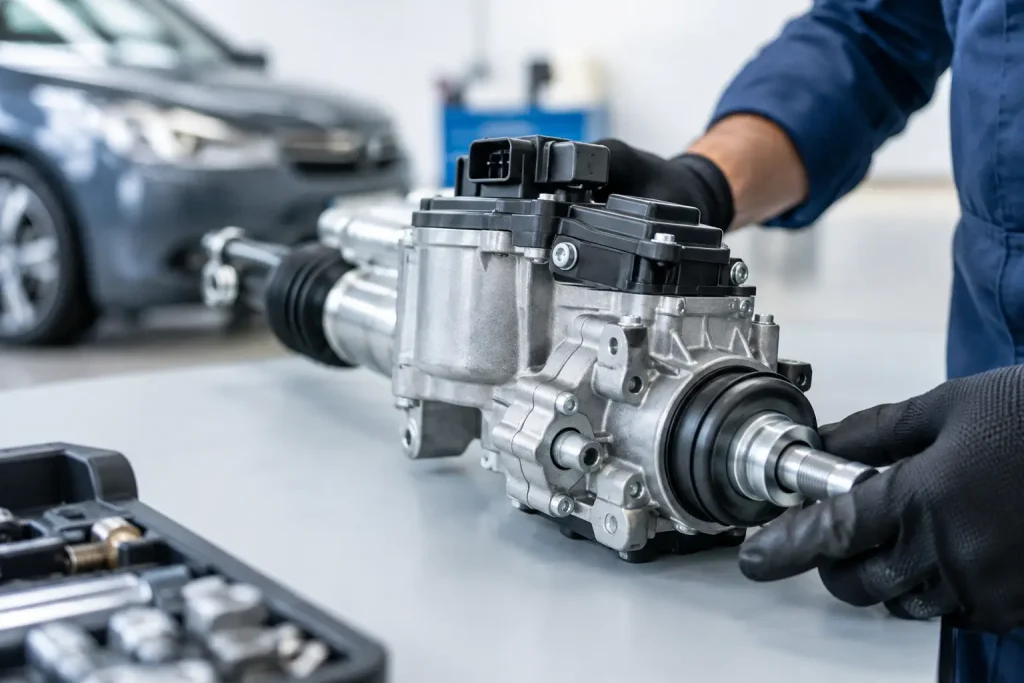
An EPS unit may be a column-mounted system, a motor mounted on the steering rack, or an integrated rack-and-control-unit assembly. The layout varies by manufacturer and model, particularly between front-wheel-drive cars, larger SUVs, performance vehicles and commercial applications. Right-hand-drive versions can have meaningful differences in rack configuration, shaft arrangement and part number, so an apparently similar unit is not necessarily suitable.
The motor receives instructions from the EPS control unit, which uses inputs including steering torque, steering angle, vehicle speed and system voltage. When the driver turns the wheel, the system calculates how much assistance is appropriate. A fault in any part of this chain can reduce assistance, produce inconsistent weighting or place the system into a protective mode.
That is why reliability cannot be judged simply by whether power assistance returns after a component has been changed. A unit that feels light in the workshop but has an unresolved communication fault, damaged wiring, incorrect coding or excessive mechanical load may not remain dependable in service.
Mechanical condition still matters
Electric assistance does not remove the need for sound mechanical steering components. Internal rack wear, water ingress, damaged gaiters, a tight universal joint, worn suspension joints or incorrect alignment can all influence steering effort and feedback. On some vehicles, abnormal resistance in the steering system can place additional demand on the EPS motor and electronics.
A reliable repair therefore starts with establishing whether the concern is genuinely within the EPS assembly. If the basic steering mechanism is binding, replacing an electronic module alone may mask the problem temporarily rather than correct it.
What Commonly Affects EPS Reliability?
EPS systems are designed to operate for many years, but their service life is influenced by heat, vibration, moisture, electrical condition and the working loads they encounter. The pattern of failure often provides useful diagnostic direction.
Intermittent faults can point towards a poor electrical connection, damaged harness, power-supply issue or an electronic component affected by temperature. Assistance that is consistently absent may relate to a stored system fault, motor failure, control unit issue or a safety-related lockout. Steering that is heavy only in one direction can suggest a mechanical issue within the rack or an irregularity in motor or torque-sensor operation.
Low battery voltage and charging-system faults deserve particular attention. EPS motors draw substantial current, especially during slow manoeuvres. If voltage falls outside the expected range, the control unit may record faults or reduce assistance to protect the system. Replacing an EPS unit without confirming battery condition, charging voltage, earth connections and power feeds can lead to an unnecessary repair or repeat fault.
Water ingress is another important consideration. Damage to seals, connectors or rack gaiters can allow moisture to reach areas that were not designed to tolerate it. Corrosion may develop gradually, making a fault intermittent before it becomes permanent. For vehicles used in demanding conditions, including fleet work, winter use or frequent short journeys, inspection for water-related damage is particularly relevant.
Diagnosis Determines the Reliable Repair Path
A warning message may identify an EPS system concern, but diagnostic codes are only the starting point. They need to be considered alongside live data, vehicle history, voltage readings, physical checks and the driver’s description of the fault.
For example, a torque-sensor code does not always mean the sensor alone is defective. The cause could involve a wiring issue, an internal control-unit fault, loss of calibration or mechanical loading that creates readings outside the expected range. Equally, a communication code may originate in the vehicle network or power supply rather than the EPS unit itself.
A proper assessment should establish whether the fault is internal to the rack, motor, column or ECU; external in the wiring, battery or vehicle network; or related to coding, calibration or alignment after previous work. This is especially important where a vehicle has had accident repairs, suspension work, a replacement steering column or a used rack fitted.
For independent garages, this approach avoids committing the customer to a complete new unit before the evidence supports it. For owners, it provides a clearer explanation of why a repair, reconditioned unit, replacement assembly or dealer-led programming route is being recommended.
When Reconditioning Can Support EPS Unit Reliability
Where an EPS assembly is suitable for repair, component-level reconditioning can be a practical alternative to complete replacement. The aim is not simply to make the original fault disappear. It is to identify worn or failed elements, replace appropriate components, inspect the surrounding assembly and test operation before the unit is returned for fitting.
Depending on the system and fault, this may involve attention to the electric motor, internal mechanical parts, sensors, electronic control elements or rack components. Suitable OE or OE-quality parts are used where applicable, and the extent of work should reflect the actual condition of the unit rather than a one-size-fits-all process.
There are limits. Severe corrosion, major impact damage, unavailable electronic parts or a unit with failures beyond economical repair may make replacement the more sensible option. Some assemblies are also restricted by manufacturer programming requirements or security measures. A specialist should be candid about those limitations before work begins.
At Pro Power Steering, suitable EPS units are assessed as steering assemblies rather than treated as generic exchange parts. That matters because the reliable answer may be a repaired original unit, a reconditioned replacement, a new component, or further vehicle-side diagnosis before any part is supplied.
Testing is not an optional final step
Bench testing gives a repaired or reconditioned unit a controlled check before it leaves the workshop. It can help confirm that the motor, sensing and assistance response perform as expected, while mechanical checks can identify unwanted play, roughness or binding.
However, bench testing does not replace installation checks on the vehicle. Once fitted, the steering system must operate with the vehicle’s own battery, wiring, modules and wheel geometry. A trustworthy process recognises the value of both workshop testing and correct vehicle commissioning.
Coding, Calibration and Alignment After EPS Work
Many modern EPS systems need vehicle-specific coding or calibration after installation. This may include configuring the rack or control unit, carrying out steering-angle-sensor calibration, clearing learned values or completing manufacturer-guided routines. In certain applicable models, an EPS rack may be flashed or virginised so it can be prepared for coding to the vehicle.
This is a point where repair quality and fitting quality meet. A correctly rebuilt unit can still behave incorrectly if it has not been configured to the vehicle, while a system that has been coded may still report faults if an underlying power, network or mechanical issue remains.
Wheel alignment is equally relevant. If the steering wheel is off-centre or toe settings are incorrect after steering or suspension work, the vehicle may not track correctly and steering-angle information may be implausible. The result can be poor steering feel, warning lights or driver-assistance systems that require further calibration. Alignment should be checked to the manufacturer’s specification when the repair process calls for it.
Garages fitting a supplied EPS unit should confirm the coding and calibration requirements before booking the job. This allows the correct diagnostic equipment, alignment capability and technical information to be available, rather than discovering a final commissioning step only after the vehicle is on the ramp.
Choosing a Dependable EPS Solution
The right option depends on the vehicle, fault findings, parts availability and the intended use of the vehicle. A low-mileage premium car with a known internal rack fault may be well suited to specialist reconditioning. A vehicle with extensive corrosion or multiple unrelated electrical concerns may need a broader repair plan. For a fleet vehicle, reducing off-road time matters, but so does ensuring the underlying cause is not carried into the replacement unit.
It is also worth considering warranty in context. A 12-month warranty on completed work provides reassurance under the applicable terms, but it cannot cover unrelated vehicle faults, unsuitable installation, accident damage or a weak charging system. Clear diagnosis and documented fitting procedures protect both the repair and the customer.
When EPS assistance changes, the safest and most cost-effective next step is usually not guesswork. It is a steering-specific assessment that separates the failed component from the conditions that caused it to fail, then confirms the repaired system is coded, calibrated and set up to deliver smooth, precise control.
