
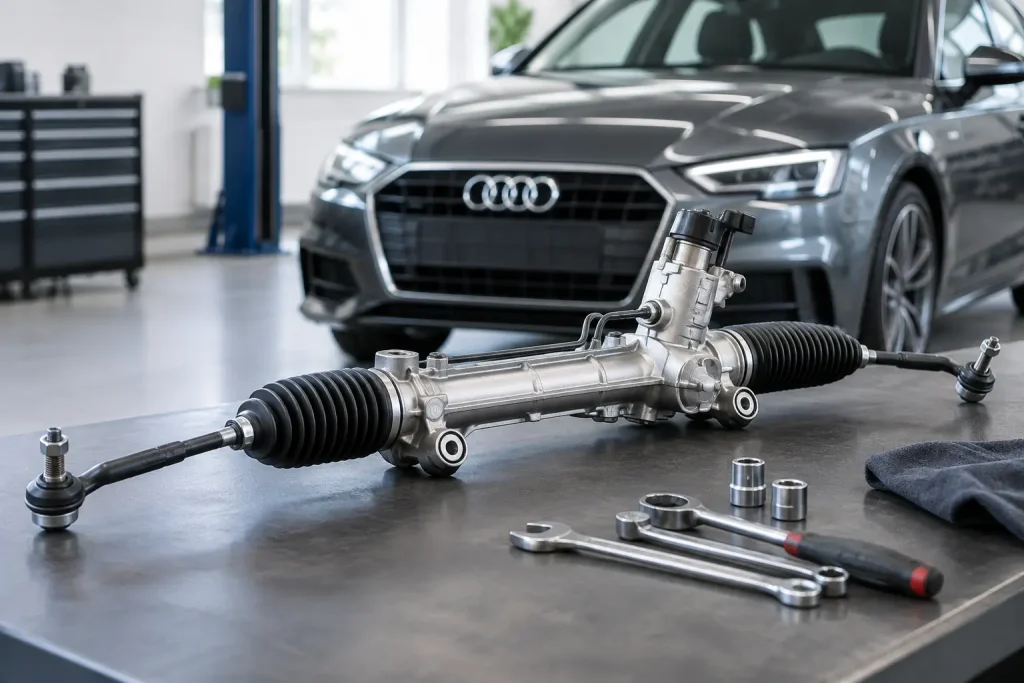
A steering warning light on an Audi can suggest a costly rack straight away, but that is rarely enough information to make the right decision. Audi steering options range from targeted diagnostics and component-level reconditioning to a new replacement unit or, on selected older and specialist vehicles, a considered power-steering upgrade. The correct route depends on the system fitted, the confirmed fault, the condition of the unit and what the vehicle needs after fitting.
The aim is not simply to make the steering wheel turn more easily. A proper repair should restore smooth, consistent assistance and accurate response while preserving the vehicle’s safety systems and intended steering feel.
Understanding Audi steering systems
Audi has used several steering designs across its range. Older models may use conventional hydraulic power steering, while many later vehicles use electric power-assisted steering, often called EPS. Some models have electromechanical racks with variable assistance, selectable driving modes or integration with lane-assist and parking-assist functions. Certain performance and higher-specification vehicles may also have dynamic steering arrangements.
These systems can produce similar driver symptoms for very different reasons. Heavy steering may be caused by a mechanical restriction in the rack, an electrical supply or communication issue, an internal EPS fault, damaged steering-column components, poor alignment or a problem elsewhere in the front suspension. A pull, wander or an off-centre steering wheel is not automatically a rack failure.
That distinction matters because Audi steering systems are vehicle-specific. The rack ratio, motor output, control module software, torque sensor data and coding requirements can vary by model, engine, drivetrain and year. A part that physically fits is not necessarily the correct part electronically or mechanically.
Audi steering options for common faults
Diagnosis before a repair decision
A fault-code scan is useful, but it is only the start. A specialist assessment considers the warning messages, steering effort in both directions, battery and charging-system condition, wiring integrity, live data where available, mechanical play and signs of water ingress or impact damage. On EPS-equipped Audis, the vehicle’s communication network and stored fault history can be as relevant as the rack itself.
For a garage, this process helps avoid ordering a rack when the underlying fault is a damaged connector, steering-angle calibration issue or a worn coupling. For an owner, it provides a clearer basis for deciding whether a repair is sensible. Diagnosis can also identify cases where the steering rack is sound but wheel alignment, suspension wear or tyres are affecting the vehicle’s behaviour.
Reconditioning the existing rack
Where a rack is suitable, reconditioning can be a practical alternative to complete replacement. This is particularly relevant where the fault is confined to serviceable internal components, seals, bearings, sensors or electronic elements that can be properly assessed and renewed.
A component-level process is more involved than fitting a used unit. The rack is stripped and inspected, damaged or worn items are identified, appropriate OE or OE-quality components are used where applicable, and the completed unit is tested before it leaves the workshop. It can retain the correct original housing and configuration for the vehicle, which is valuable where Audi part numbers and mounting arrangements are specific.
Reconditioning is not appropriate for every rack. Severe crash damage, extensive corrosion, a compromised housing, unavailable electronic parts or certain internal failures may rule it out. A specialist should be clear about those limits rather than treating refurbishment as a universal answer.
Reconditioned exchange or supply-only units
When downtime matters, an exchange unit can be the more practical route, provided an equivalent unit is available and correctly matched. This can suit independent garages, fleet operators and owners whose vehicle needs to return to service promptly. Matching should account for the precise part number, handedness, vehicle specification and whether the rack is hydraulic or EPS.
With modern Audi EPS racks, a supplied unit may require software preparation before installation. On applicable models, flashing or virginising can prepare the rack for vehicle-specific coding. It does not remove the need for correct fitting, coding and calibration once the rack is installed. A fitting garage must have suitable diagnostic capability, or arrange access to it.
A used steering rack may appear to offer the lowest initial price, but it can bring uncertainty around internal wear, water damage, software compatibility and provenance. It may also create difficulties if the part cannot be coded correctly or develops a fault shortly after installation. Used components can have a place in some circumstances, particularly for older vehicles, but they should be chosen with a realistic view of the risk.
New replacement racks
A new replacement rack is sometimes the right answer. It may be required where the original unit is beyond economic repair, the necessary parts are unavailable, or a manufacturer-specific software and parts route is needed. For late-model vehicles with complex driver-assistance systems, dealer involvement may be necessary for programming or online functions.
New does not automatically mean straightforward. The correct rack must still be identified, installed without damage to related components, coded where required and followed by calibration and wheel alignment. It is also worth confirming exactly what is included, as motors, control modules, track rods and sensors may not always be supplied in the same configuration.
Coding, calibration and alignment after fitting
Replacing or refitting an Audi steering rack is only part of the job. Many EPS systems need coding so the vehicle recognises the module, followed by basic settings or calibration procedures. The steering-angle sensor may also need resetting. If these steps are missed or incomplete, warning lights, restricted assistance or driver-assistance faults can remain even when the mechanical installation is correct.
Wheel alignment is equally important. Removing a rack or disturbing steering components changes the relationship between the steering wheel, track rods and front-wheel geometry. The vehicle should be aligned to the appropriate specification once the repair is complete. This protects tyre wear, helps the car track correctly and ensures the steering wheel sits straight.
On vehicles fitted with advanced driver-assistance features, calibration requirements can extend beyond the rack itself. The exact procedure depends on the Audi model and equipment level. A careful repair plan identifies this before work begins, not after the vehicle is reassembled.
Upgrading steering on older and specialist Audis
For classic, restoration and specialist projects, the question may not be a failure at all. An owner may want lighter steering at parking speeds or a more usable road car without losing predictable feedback. Electric power-steering conversions can be considered for suitable older vehicles where the original steering is manual or where an alternative arrangement is being planned.
This is a vehicle-engineering decision rather than a simple accessory fitment. Column geometry, steering-shaft joints, mounting strength, electrical supply, assistance control and fail-safe behaviour all need to be considered. Too much assistance can leave a car vague; too little may defeat the purpose. The best result retains a natural, consistent feel and does not compromise safe operation.
Modifications also need to be appropriate for the vehicle’s intended use, insurance position and roadworthiness requirements. Not every classic or performance Audi is a suitable candidate, and original equipment restoration may be the preferred route for some vehicles.
Choosing the right route for your Audi
The most cost-effective option is the one that addresses the confirmed fault and leaves the car correctly configured. That may be a repair to the existing unit, a tested reconditioned rack, a new replacement assembly or a carefully engineered upgrade. Price matters, but it should be considered alongside parts availability, vehicle downtime, coding requirements and long-term confidence in the repair.
Pro Power Steering assesses suitable units at component level and supports customers and fitting garages with steering diagnostics, reconditioning, tested supply options and technical guidance. Completed work is supported by a 12-month warranty under the applicable terms.
If your Audi has developed heavy steering, an EPS warning, inconsistent assistance or poor directional control, begin with a proper diagnosis and the exact vehicle details. That gives you the best chance of restoring the precise, predictable steering the car was designed to deliver.
