
A warning light and suddenly heavy steering do not automatically mean the electric motor has failed. Understanding how garages test EPS motors starts with separating a genuine motor fault from the power, sensor, wiring, mechanical or software faults that can produce much the same symptom. Replacing an EPS rack or column without that evidence can be expensive and may leave the original problem unresolved.
Electric power steering, usually shortened to EPS, uses an electric motor to provide steering assistance when the vehicle needs it. Depending on the design, the motor may sit on the steering column, pinion housing or rack itself. The system also relies on control electronics, torque and position sensors, a dependable battery supply, vehicle network communication and a mechanically sound steering assembly. A proper test process considers the whole system before a specialist decides whether the motor can be repaired, the unit can be reconditioned, or replacement is the appropriate route.
How garages test EPS motors on the vehicle
The first stage is usually a structured diagnostic assessment with the EPS unit still fitted. This matters because a motor that appears faulty on a bench may be reacting to a fault elsewhere in the vehicle, while a removed unit may no longer show the operating conditions that triggered the original complaint.
Confirming the reported steering fault
A technician begins with the driver’s description and a controlled check of the symptom. Assistance may be absent all the time, intermittent, heavier in one direction, or only lost after the vehicle has warmed up. There may be a steering warning lamp, messages on the instrument display, noises during parking manoeuvres or an off-centre steering wheel following previous suspension work.
These details help narrow the test route. For example, steering that is uniformly heavy with no electrical warning may point towards mechanical binding, seized joints, incorrect geometry or tyre-related issues rather than the EPS motor itself. A motor-related fault can also be intermittent, especially where heat, vibration or internal electrical resistance affects performance.
Reading fault codes and live data
A suitable diagnostic tool communicates with the vehicle’s steering control module and other relevant modules. Stored and current fault codes can identify concerns such as motor circuit faults, over-temperature events, torque sensor correlation errors, supply voltage problems or lost communication on the vehicle network.
Fault codes are a starting point, not a final diagnosis. A code referring to motor performance does not always prove that the motor is defective. The control module may have detected excessive current because the rack is tight mechanically, or may have reduced assistance after seeing low voltage. Technicians therefore compare fault information with live data, including steering angle, torque sensor readings, commanded assistance, motor current and system voltage where the vehicle permits it.
Plausible live data is particularly useful. If the steering torque sensor does not respond consistently as the wheel is turned, the module may not command the motor correctly. If a command is present but current draw is abnormal, attention moves closer to the motor circuit, internal electronics or a mechanical load.
Checking the battery, charging and high-current feeds
EPS systems can demand significant current at low vehicle speed. A weak battery, poor earth, corroded connection, voltage drop under load or charging-system fault can make a healthy steering motor appear unreliable. This is why supply and earth checks should be carried out under appropriate load conditions, rather than relying only on a static battery voltage reading.
The technician checks the relevant fuses, relay arrangements where fitted, connector condition and voltage at the steering unit. On some vehicles, the EPS module receives more than one supply feed or depends on network wake-up signals from other modules. A missing ignition feed or poor earth can prevent the system from operating even though the motor itself is serviceable.
Ruling out mechanical resistance
An EPS motor does not work in isolation. If the rack, column universal joint, track rod end, top mount or another steering and suspension component is binding, the system has to work harder to turn the wheels. In some cases, the control module will limit assistance to protect the motor and electronics.
A workshop inspection checks for excessive steering effort, stiffness through part of the travel, impact damage and free movement where practical. Wheel alignment is also relevant after steering repairs or if the steering wheel is not centred. Alignment will not cure an electrical motor fault, but incorrect geometry can affect steering feel and can complicate calibration procedures on vehicles that use steering-angle information.
Testing the EPS motor and electronics more closely
If vehicle-level diagnosis indicates a fault within the steering unit, the rack or column may be removed for specialist assessment. The exact scope depends on the design. Some motors and control modules are integrated into a sealed assembly, so diagnosis and repair must be undertaken at unit level rather than by replacing an individual motor component.
Electrical checks
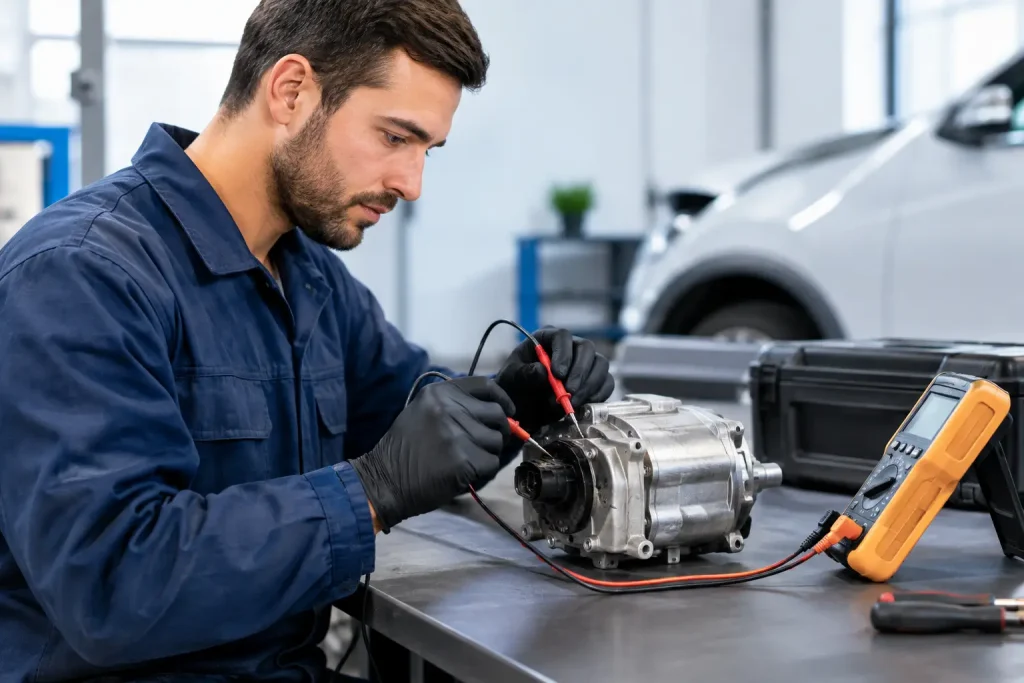
With the unit accessible, specialists inspect the motor connections, terminals, wiring paths and casing for evidence of water ingress, overheating, impact or previous incorrect repair. Electrical tests can assess winding continuity, resistance balance and insulation condition. Readings outside the manufacturer’s expected range may indicate a shorted, open-circuit or damaged winding.
However, resistance alone is not enough to condemn or approve an EPS motor. Some internal failures only become apparent when the motor is operating under load or at temperature. Specialist testing may therefore combine electrical measurements with controlled operation and analysis of current draw. Excessive current, uneven operation or abnormal heat generation can reveal a fault that a simple continuity check will miss.
Bench testing and simulated operation
Where the unit design allows, a specialist workshop can test the EPS rack, column or motor assembly on dedicated equipment. The objective is to reproduce relevant inputs safely and observe whether the unit delivers consistent assistance, responds to torque demand and operates across its travel without irregular noise, binding or unexpected cut-out.
Bench testing is valuable after component-level reconditioning as well as before it. It provides an opportunity to verify the repair under controlled conditions, but it has limits. A bench cannot always replicate every vehicle network message, road load, temperature condition or calibration state. Final confirmation still requires correct installation, coding where required and a vehicle-level function check.
For this reason, a reliable repair process does not rely on a single pass or fail measurement. It builds evidence from the vehicle fault, diagnostic data, supply checks, mechanical condition and workshop testing.
When the motor is not the real fault
A sizeable proportion of suspected EPS motor failures turn out to be related to another part of the steering system. Torque sensors, steering-angle sensors, internal control modules and vehicle wiring can all cause loss of assistance or warning messages. Water ingress can damage electronics as well as motor components, and an accident-damaged rack housing may create both mechanical and electrical concerns.
Software configuration also matters. Some replacement or reconditioned units require vehicle-specific coding, flashing, virginising or calibration before they can operate correctly. A steering-angle calibration may be needed after repair, while other vehicles require the replacement unit to be recognised by the vehicle’s security or network systems. In these cases, a good unit can still appear faulty until the required programming procedure has been completed.
There are also occasions where repair is not sensible. Severe housing damage, unavailable internal parts, extensive corrosion, irreparable electronic damage or a unit that fails validation testing may mean replacement is safer and more economical. The right decision depends on the exact part number, vehicle application and condition of the unit, particularly on specialist and Right Hand Drive steering systems where the incorrect variant may not fit or communicate correctly.
What happens after an EPS repair
Once an EPS unit has been repaired or reconditioned, it should be tested before it leaves the specialist workshop. At Pro Power Steering, suitable units are assessed at component level and tested following reconditioning, with applicable EPS racks prepared for the coding and calibration requirements of the vehicle.
The fitting garage then has an equally important role. It must install the unit correctly, inspect related steering components, carry out coding or calibration where specified, clear relevant faults and confirm steering operation. Wheel alignment should be checked when the work has disturbed steering geometry. A road test, carried out safely and in accordance with workshop procedures, confirms that assistance is smooth, the steering returns appropriately and no warning messages return.
For vehicle owners, the useful question is not simply, “Has the EPS motor been tested?” Ask what was found in the diagnostic process, whether the power supplies and mechanical steering condition were checked, and what coding or calibration will be needed after fitting. Clear answers provide the best basis for a safe, precise repair rather than an unnecessary replacement.
