
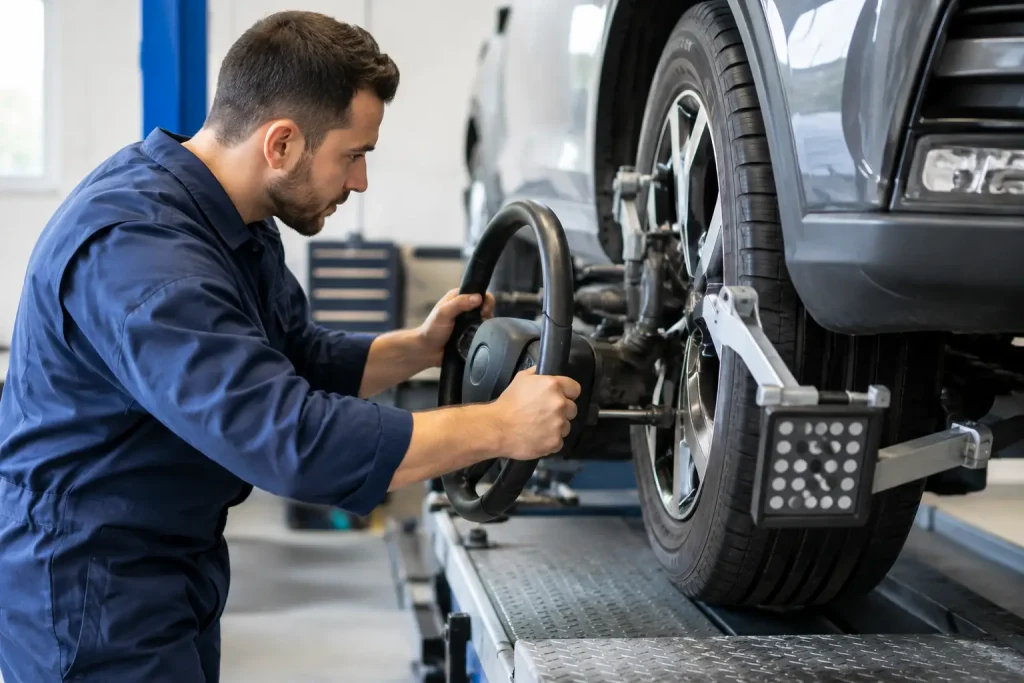
A steering wheel that moves before the wheels respond is more than an annoyance. It can make a vehicle wander, dull its response through bends and reduce driver confidence, particularly at motorway speeds or when towing. Understanding how garages assess steering play helps owners and workshops distinguish between a simple worn joint, an alignment-related concern and a fault within the steering rack, box, column or assistance system.
Steering play is not diagnosed from the driver’s seat alone. A reliable assessment follows the movement from the steering wheel to the road wheels, identifying exactly where response is being lost. On modern vehicles, that process may also include electronic steering diagnostics, coding checks and calibration requirements.
How garages assess steering play from the driver’s seat
The first stage is to confirm the complaint during a controlled road test. A technician will consider how much steering-wheel movement is needed before the vehicle changes direction, whether the concern is worse on particular road surfaces, and whether it appears consistently or intermittently.
They will also look for clues that point away from true mechanical play. A vehicle pulling to one side, a steering wheel sitting off-centre or a tendency to follow road camber can be caused by tyre condition, tyre pressures, wheel alignment or suspension geometry. These faults can make the steering feel vague, but they do not necessarily mean there is excess clearance in the steering mechanism.
The character of the steering matters. A knock as the wheel is moved through a small arc may suggest a worn joint, column coupling or mounting. A notch or tight spot can indicate internal rack or column wear. Heavy, inconsistent assistance may point towards a hydraulic or electric power-steering issue rather than play alone. On an electric power steering system, warning lights, intermittent assistance or stored fault codes add another layer to the diagnosis.
Measuring where movement is lost
Back in the workshop, the technician will hold the road wheels straight and gently move the steering wheel from side to side through the small amount of movement before the tyres react. A second technician may observe the steering linkage underneath the vehicle. This simple comparison is valuable: if the steering wheel moves but a component below does not, the lost movement can be located rather than guessed.
There is no useful universal figure for acceptable free play. Vehicle design, steering ratio and tyre size all affect how a steering system feels. Older vehicles with a recirculating-ball steering box can have a different character from a modern car with a quick-ratio electric rack. The question is whether the movement is excessive for that vehicle and whether it is caused by a worn or incorrectly adjusted component.
Steering wheel, column and intermediate shaft
Inspection starts at the top of the system. The steering wheel itself must be secure, while the column is checked for movement in its mountings, damaged bearings and looseness in adjustment mechanisms. The intermediate shaft and its universal joints are then examined. Wear in these joints can create a delayed, disconnected feel at the wheel, sometimes accompanied by a clunk when changing direction.
On some models, access is restricted and the source of the movement is not obvious with the vehicle on the ground. Correct inspection may require the vehicle to be raised safely and, where appropriate, trims or undertrays to be removed. This is one reason a visual glance at the rack is not a complete steering assessment.
Track rods, ball joints and suspension joints
The outer track-rod ends, inner track rods and their rack joints transfer rack movement to the wheel hubs. Any wear here can produce steering play, tyre wear and imprecise turn-in. A technician checks for movement while the steering is loaded and unloaded, rather than relying solely on a general wheel shake.
Lower ball joints, wishbone bushes, top mounts and wheel bearings can also imitate steering play. If the wheel moves because a suspension joint shifts under load, the driver may feel it as vagueness through the steering wheel. A proper diagnosis separates steering-linkage clearance from suspension movement, as replacing the wrong component may leave the original complaint unchanged.
Steering rack or steering box inspection
Once external joints are ruled out or assessed, attention turns to the rack or steering box. On a rack-and-pinion system, the technician checks the rack mountings, pinion input and inner joints, then observes whether the rack begins moving as soon as the steering shaft is turned. A delayed response within the unit, uneven resistance or a knock from the rack area may indicate internal wear.
A steering box requires a different approach. Excessive clearance can arise from internal wear, adjustment, mounting movement or wear in associated linkages. Adjustment is not a universal cure. Tightening a box without confirming its condition can create binding around the straight-ahead position, reduce self-centring and mask a worn component. The correct repair depends on the box design and the condition found during inspection.
Leaks deserve attention but do not automatically explain steering play. A leaking hydraulic rack may still be mechanically sound, while a dry rack can have significant internal wear. Likewise, an EPS rack may have no fluid system at all, yet develop play in its mechanical gearing or an assistance concern in its motor, torque sensor or control electronics.
Diagnostic equipment for modern steering systems
Electronic power steering has made accurate fault-finding more vehicle-specific. A diagnostic scan can reveal communication faults, torque-sensor plausibility errors, motor faults, voltage issues and calibration status. However, a fault code is evidence, not a complete diagnosis. A code should be considered alongside the road test, physical inspection and live data where available.
After a rack, column or related component is replaced or reconditioned, some vehicles need steering-angle sensor calibration, end-stop learning, EPS configuration or vehicle-specific coding. Alignment may also be required after track-rod work or any repair that changes steering geometry. Skipping these steps can leave warning lights, uneven assistance, off-centre steering or driver-assistance faults even when the mechanical repair is correct.
Deciding between adjustment, repair and replacement
The final recommendation should be based on the confirmed source of the play, not on the easiest component to quote. A worn track-rod end may be a straightforward replacement followed by alignment. A damaged intermediate shaft may require a vehicle-specific part. A rack with internal wear may be suitable for component-level reconditioning, provided the unit and parts availability allow it.
For suitable units, a steering specialist can assess the rack or box at component level, replace worn internal parts using appropriate OE or OE-quality components where applicable, and test the finished unit before it leaves the workshop. This can be a practical alternative to replacing the whole assembly, particularly where new parts are expensive or difficult to source. It is not appropriate in every case: severe housing damage, unavailable electronics, corrosion or model-specific restrictions can make replacement the more reliable route.
Pro Power Steering supports garages and owners with steering diagnostics, reconditioning and supply-and-fit solutions across hydraulic, manual and electric systems, including Right Hand Drive applications. Where EPS work is applicable, units may also need flashing or virginising before correct coding and calibration on the vehicle.
Why alignment is checked after steering work
Wheel alignment does not remove mechanical play, but it is essential once worn steering components have been replaced or steering settings have been disturbed. Toe settings directly influence straight-line stability, tyre wear and steering-wheel position. On vehicles with advanced driver-assistance systems, calibration requirements may extend beyond conventional alignment.
A good result is therefore not simply a new part and a quieter front end. The steering should respond promptly, self-centre naturally where the design permits, track accurately and operate without warning lights or abnormal assistance. If the steering still feels vague after an initial repair, the vehicle should be reassessed rather than assuming the fault has been cured.
Steering play is best treated as a traceable loss of movement, not a generic symptom. When each connection from wheel to tyre is tested in sequence, the repair can be targeted at the component that is actually preventing smooth, precise control.
