
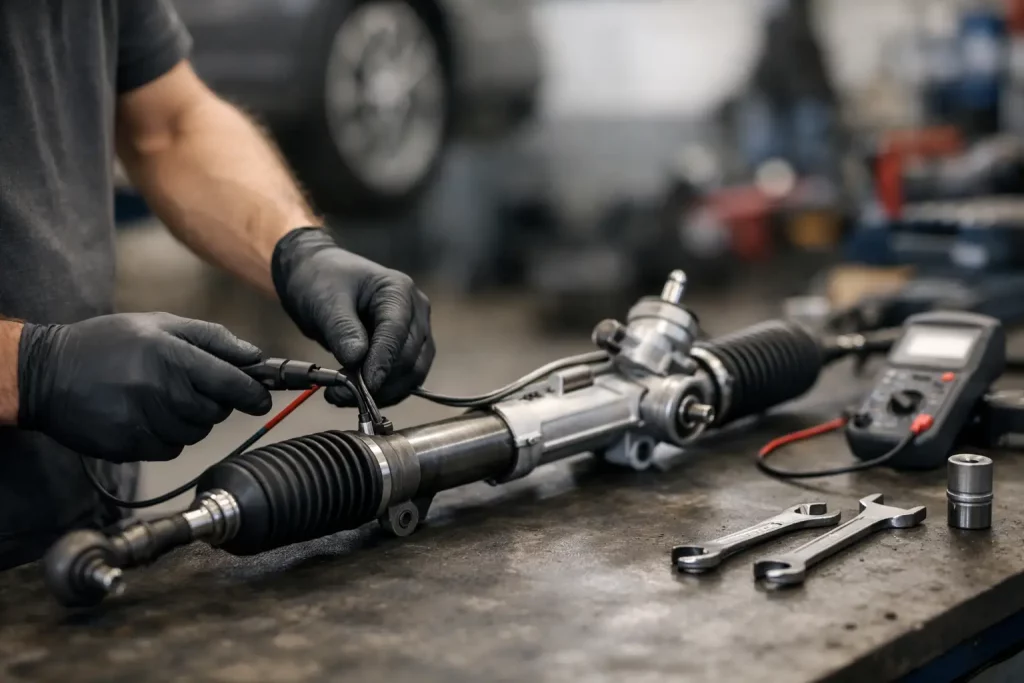
A steering complaint rarely arrives with a neat diagnosis attached. A driver may report a knock through the wheel, a vague feeling around the straight-ahead position, intermittent heavy steering or an EPS warning light. To test steering rack performance properly, those symptoms must be separated from faults in the tyres, suspension, steering column, track rod ends, alignment settings and electronic control system.
That distinction matters. Replacing a rack because the vehicle pulls to one side, for example, will not correct a tyre issue, a worn suspension bush or poor wheel alignment. Equally, dismissing play as an alignment concern can leave a genuine internal rack fault unresolved. Accurate steering diagnostics protect safety, avoid unnecessary parts replacement and give the fitting garage a clear repair route.
Why a steering rack test needs a full-system view
The rack is only one part of the steering system. It converts the driver’s movement at the steering wheel into movement at the road wheels, but its operation depends on the column and shafts, outer steering joints, subframe mounting, suspension geometry and, on modern vehicles, electrical inputs and software.
A professional assessment begins with the customer’s description of the problem. Does the steering become heavy only when parking? Is there a knock over rough surfaces, or only as the direction changes? Does the wheel fail to self-centre after a bend? Has the fault appeared after impact damage, suspension work or a flat battery? The answers help distinguish a mechanical concern from an intermittent electronic one.
A road test, where appropriate and safe, can reveal whether the symptom changes with vehicle speed, steering load, temperature or road surface. This is followed by workshop inspection, with the vehicle raised correctly so components can be checked under controlled conditions. The aim is not simply to find movement, but to identify where that movement originates and whether it is within acceptable limits.
How specialists test a steering rack
Checking the steering feel and free play
With the vehicle stationary or on a suitable ramp, the steering wheel is moved through its initial travel while the joints and rack assembly are observed. Excessive free play can come from a worn internal rack guide, a pinion issue, a loose inner joint, a steering column coupling or an outer track rod end. These parts can produce similar symptoms at the steering wheel, so visual checks alone are not enough.
The technician will also assess whether the effort is even from lock to lock. A tight spot, notchiness or inconsistent resistance may indicate internal wear, corrosion on the rack bar, damage to the pinion area or a problem elsewhere in the steering linkage. On older and classic vehicles, the condition of mounting points and couplings can be as relevant as the rack itself.
Inspecting the rack housing, gaiters and mountings
The rack housing and its mountings are examined for security, impact damage and signs that the unit has moved under load. A rack that shifts in its mountings can feel imprecise or produce a knock, even where the internal mechanism remains serviceable.
The gaiters are also significant. A split or displaced gaiter allows water and road contamination to reach the inner joint and rack bar. Over time, this can cause corrosion and damage to the sealing surfaces. On hydraulic systems, fluid found within a gaiter can point to an internal seal failure, although the source must be confirmed before deciding whether the rack is the cause.
Separating rack wear from suspension and alignment faults
A steering wheel that sits off-centre, a vehicle that drifts or uneven tyre wear do not automatically indicate a failed rack. These are often geometry-related symptoms. Camber, caster and toe settings, bent suspension arms, tyre condition and previous collision damage all need consideration.
Wheel alignment is normally checked after steering or suspension work, but it can also be an essential diagnostic step. Alignment readings can show whether the vehicle’s geometry is contributing to poor directional stability or an off-centre steering wheel. They cannot, on their own, prove that an internal rack is sound, nor can they compensate for excessive mechanical play.
A useful test also checks the steering system with load applied. A component may appear acceptable with the wheels hanging free yet show movement when the tyre is supporting the vehicle’s weight. This is why a methodical inspection is more reliable than a quick shake of the wheel.
Testing electric power steering racks
Electric power steering, often called EPS, adds another layer to diagnosis. An EPS rack may contain an electric motor, torque sensor, position sensing, control electronics and vehicle-network communication. Heavy or intermittent steering can therefore result from a mechanical issue inside the rack, but it may also relate to low battery voltage, poor wiring, a steering angle sensor, a control module fault or lost calibration.
Diagnostic equipment is used to read fault codes, inspect relevant live data and establish whether the system is receiving the correct supply and communication signals. Fault codes should guide the investigation, not replace it. A stored code may record an earlier low-voltage event, while a current mechanical fault may not always create a clear electronic code.
The rack’s response can then be assessed alongside the vehicle’s charging condition and steering inputs. Some faults occur only when the system is warm or under parking load. Others are linked to water ingress, damaged connectors or wiring faults outside the rack. Replacing the entire assembly without these checks can be expensive and may still leave the original issue present.
Where an EPS rack is repaired or replaced, coding and calibration may be required. Depending on the vehicle, this can include steering angle calibration, end-stop learning, torque-sensor set-up or vehicle-specific programming. Certain units may need flashing or virginising before coding. The exact process depends on the manufacturer, model and the part fitted, so it should be confirmed before work begins.
What the test results mean for repair
Once the source of the fault is established, there are usually several possible outcomes. A worn external joint, loose mounting or alignment issue may be resolved without rack reconditioning. If the rack itself has internal wear, corrosion damage, leakage or an electronic fault, a specialist assessment can establish whether component-level repair is suitable.
Reconditioning is not the right answer for every rack. Severe housing damage, unavailable electronic components, extensive corrosion or manufacturer restrictions can make replacement the more practical option. Likewise, a vehicle may need dealer-level programming or additional calibration equipment after an EPS repair. Honest diagnosis means recognising these limits before a component is removed or ordered.
For suitable units, specialist reconditioning can address the failed elements rather than treating the rack as a disposable assembly. The unit should be rebuilt with appropriate OE or OE-quality components where applicable, then tested before it leaves the workshop. This gives garages and owners a clearer basis for fitting, while retaining the option of technical support if vehicle-specific questions arise.
For Right Hand Drive vehicles in particular, correct part identification is essential. Similar-looking racks may have different motor specifications, sensor arrangements, pinion positions, software requirements or pipe configurations. Vehicle registration details are helpful, but chassis number, original part number and a description of the fault often provide a more reliable starting point.
When not to continue driving
Some steering symptoms should be treated as urgent. Significant free play, sudden changes in steering weight, a steering wheel that catches or fails to return, visible fluid loss from a hydraulic rack, or an EPS warning accompanied by reduced assistance all justify prompt inspection. If steering control feels unpredictable, the vehicle should not be driven until it has been assessed.
A warning light alone does not always mean the rack has failed, but it does mean the system has identified a condition requiring diagnosis. Clearing the fault without finding its cause is unlikely to provide a dependable repair.
Pro Power Steering assesses suitable steering components at specialist level, with reconditioning, testing and technical support available for a wide range of hydraulic, manual and electric systems. The most useful next step is to record exactly when the symptom occurs and have the complete steering system examined before committing to a repair path.
