
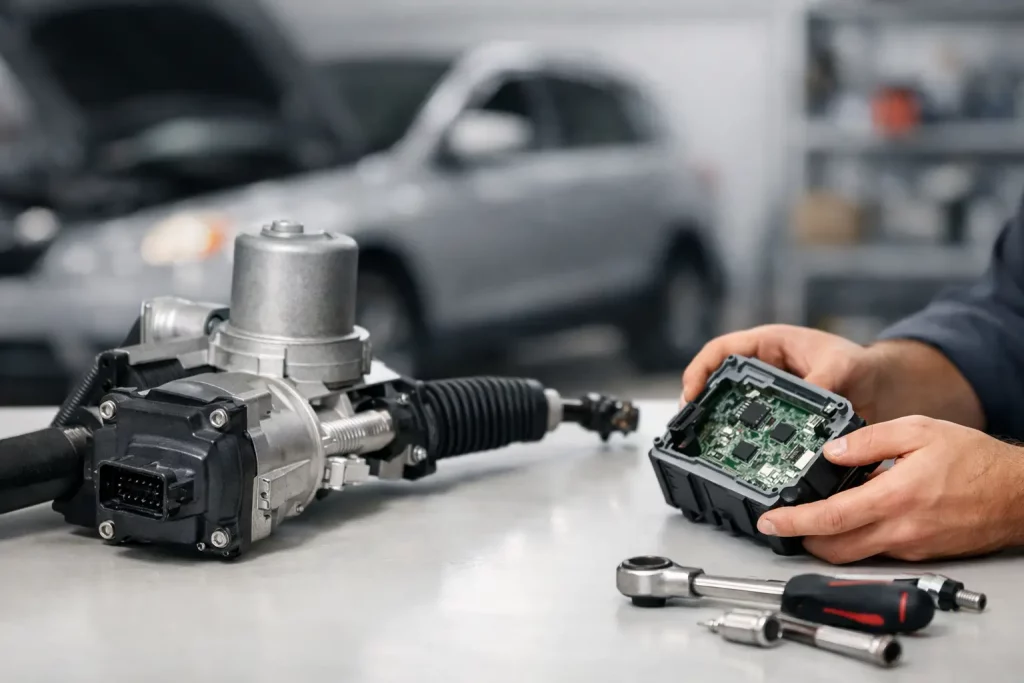
A steering warning lamp and suddenly heavy assistance can make a modern vehicle feel far more serious than an ordinary electrical fault. To repair an EPS module correctly, the fault has to be traced beyond the dashboard message and assessed in the context of the complete steering system. The module may be at fault, but so might its power supply, wiring, motor, torque sensor, rack mechanism or vehicle configuration.
Electric power steering is fitted to a wide range of cars and vans because it can vary assistance according to vehicle speed, reduce engine load and support driver-assistance functions. That sophistication also means an EPS repair is rarely a case of fitting a used electronic unit and hoping for the best. Accurate diagnosis, suitable reconditioning and, where required, coding and calibration are what return the steering to smooth, precise and predictable operation.
What an EPS module does
The EPS module is the control unit responsible for interpreting steering inputs and commanding the electric motor that provides assistance. Depending on the vehicle design, it may be integrated into the steering rack, mounted on the column or located separately. It receives information from sensors within the steering system and, on many vehicles, communicates with other control units over the vehicle network.
Its decisions are based on factors such as steering torque, steering angle, road speed and system voltage. At parking speeds it commands greater assistance; at higher speeds it reduces assistance to preserve feel and stability. On vehicles with lane support or active safety systems, the steering system may also need accurate angle information and correct communication with braking and driver-assistance modules.
A problem within the module can therefore cause more than heavy steering. It can produce intermittent assistance, a warning message, inconsistent steering weight, stored communication faults or a vehicle that will not accept coding after a repair. However, similar symptoms can originate elsewhere, which is why fault-code reading alone is not a complete diagnosis.
Signs an EPS module may need repair
A warning light is the obvious sign, but the driver experience often provides equally useful clues. Assistance may disappear completely after start-up, cut in and out while manoeuvring, or become noticeably uneven from one lock direction to the other. Some faults appear only when the system is hot, after a period of driving or in damp conditions.
Low battery voltage and charging faults can also trigger EPS warnings. Electric steering systems draw substantial current, particularly at low speed, so a weak battery, poor earth connection or high-resistance cable can imitate an internal module failure. A professional assessment should establish whether the steering unit is receiving the correct supply and earth before the module is condemned.
Other warning signs include communication codes, torque-sensor plausibility faults, motor circuit faults and configuration errors. The meaning of each code depends on the manufacturer and the live data around it. A code for a motor or sensor does not automatically mean that component alone can be replaced, nor does it prove the control unit itself has failed.
Mechanical faults can look electronic
Not every heavy or inconsistent steering complaint is electronic. A binding steering joint, damaged rack mechanism, seized mount, worn column component or alignment issue can change steering effort and create symptoms that feel similar to EPS trouble. On some systems, excessive internal rack resistance can place an abnormal load on the motor and lead to secondary fault codes.
This is particularly relevant where a vehicle has kerbed a wheel, suffered impact damage or had previous steering work. The repair route should address the cause, not simply clear the warning light or replace the most visible component.
How specialists diagnose an EPS fault
Proper EPS diagnosis begins with the vehicle history. When did the fault first occur? Is it permanent or intermittent? Has the battery been replaced, has water entered the vehicle, or has the rack, column, suspension or subframe recently been removed? These details help determine whether the likely issue is internal, electrical, mechanical or configuration-related.
The next stage is a structured test process. This normally includes a full diagnostic scan, inspection of fault codes and freeze-frame information, and checks of the battery condition, charging voltage, fuses, power feeds and earth points. Live data can reveal whether the steering torque sensors agree, whether the module sees a valid steering angle and whether the motor is being commanded correctly.
Where the steering rack or column is removed for specialist assessment, the unit can be inspected at component level. The condition of connectors, wiring paths, seals, motor components, sensors and internal mechanical parts all matters. Suitable units can then be reconditioned with appropriate OE or OE-quality components where applicable, rather than treating every failure as a reason for complete replacement.
At Pro Power Steering, the emphasis is on identifying the actual fault and assessing whether the specific unit is a viable candidate for repair. This gives owners and garages a clear basis for deciding between reconditioning, replacement or further vehicle-side investigation.
Repairing an EPS module versus replacing the complete unit
A repair can be the sensible route when the underlying fault is isolated and the unit is structurally suitable for reconditioning. Component-level work may address known electronic, sensor or motor-related issues, subject to the design of the rack or column and the availability of suitable parts. It can be a practical alternative to replacing an entire assembly unnecessarily, especially on vehicles where new parts are costly or subject to long supply times.
There are limits. Severe water damage, crash damage, extensive corrosion, damaged housings, unrecoverable software faults or mechanical wear beyond economical repair may make replacement the better decision. Some manufacturers also restrict the availability of individual internal parts or require a replacement unit under particular circumstances.
Used components can appear attractive, but they carry their own risks. Their history and remaining service life may be unknown, and an apparently identical module can have incompatible hardware, software or vehicle configuration. A used rack or column may also require coding before it operates correctly. It should not be assumed that fitting it will resolve the original issue.
A reconditioned unit that has been assessed and workshop tested offers a more controlled option where repair is suitable. It also allows the workshop fitting the component to receive direct technical guidance if questions arise during installation.
Coding, flashing and calibration after EPS repair
Electronic steering repairs often continue after the physical unit has been fitted. The exact requirements vary by manufacturer, model year and system architecture, but replacement or repaired EPS components may need vehicle-specific coding, parameterisation or software programming.
For applicable models, an EPS rack may be flashed or virginised in preparation for coding to the vehicle. This does not remove the need for the correct diagnostic equipment or procedures at the fitting stage. In some cases, dealer-level software access or a suitably equipped specialist is still required.
Calibration is equally significant. A steering angle sensor calibration may be needed after repair, and wheel alignment should be checked when a rack, subframe, steering column or related suspension component has been disturbed. If the steering wheel is not centred or alignment angles are outside specification, the EPS and associated safety systems may not interpret the vehicle’s direction correctly.
This is not simply an electronic housekeeping task. Correct coding and calibration help ensure the vehicle delivers the expected steering assistance and that connected systems receive reliable data.
What a dependable repair process should include
The most reliable outcome comes from treating EPS as a complete system rather than an isolated black box. Before authorising work, owners and workshops should expect a clear explanation of the identified symptoms, diagnostic findings and the proposed repair route. If there is uncertainty, further testing may be more appropriate than ordering a part.
For a suitable repair, the unit should be rebuilt carefully, tested before leaving the workshop and supplied with realistic fitting requirements. The installer should also know whether coding, calibration, alignment or additional checks will be necessary once the component is back on the vehicle.
This approach is particularly valuable for right-hand-drive steering systems, specialist vehicles and older premium models where the exact rack, column or software variant matters. Small differences in part numbers, connectors and configuration can have a major effect on compatibility.
Completed steering repair work should be supported by clear warranty terms. A 12-month warranty on applicable completed work provides reassurance, but it does not replace the need to rectify external wiring faults, low-voltage issues, impact damage or incorrect vehicle configuration that could affect the replacement or repaired unit.
When EPS assistance changes, a warning lamp appears or a repaired unit will not code correctly, the useful next step is not guesswork. A steering-specific assessment can establish whether the module can be repaired, what supporting work is required and how to return the vehicle to safe, accurate steering.
