
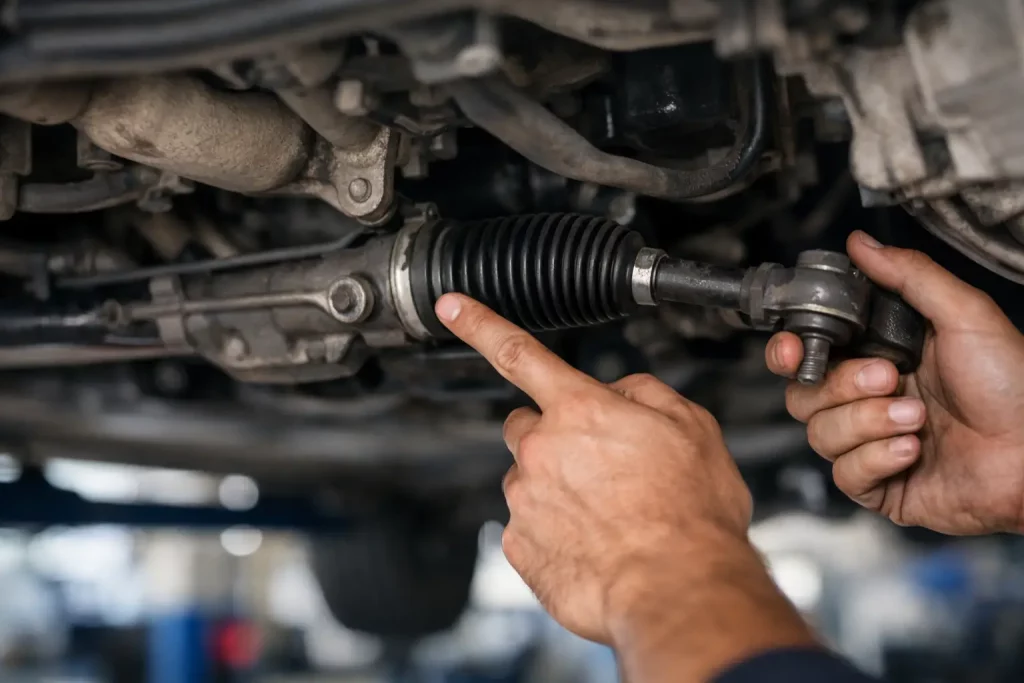
A knock through the steering wheel or from beneath the front of the vehicle can be unsettling, particularly when it appears over broken road surfaces or during low-speed manoeuvres. Knowing how to identify rack knocking helps narrow down the cause, but it does not automatically mean the steering rack is at fault. Suspension joints, track rod ends, steering columns, subframe mountings and even brake components can all produce similar noises.
The key is to look at when the knock occurs, where it can be felt, and whether it is accompanied by a change in steering quality. A properly diagnosed fault protects both safety and repair cost. Replacing a rack without confirming the source of the noise can leave the original problem unresolved.
What does rack knocking sound and feel like?
Rack knocking is usually described as a dull clunk, tap or rattle from the front of the vehicle. It may be most noticeable when driving slowly over potholes, uneven tarmac, speed cushions or rough estate roads. Some drivers feel a corresponding knock through the steering wheel, especially when the wheel is moved lightly from side to side.
A worn rack can also create a sense of free movement before the wheels respond. The steering may still feel generally serviceable on a smooth road, yet become less precise around the straight-ahead position. On certain vehicles, particularly heavier premium cars, vans and performance models with wide tyres, a small amount of wear can become much more obvious over poor road surfaces.
The noise alone is not enough for a reliable diagnosis. A steering rack sits among several components that transfer road forces and steering input, so sound can travel through the subframe and body structure. What appears to come from one side of the car may originate elsewhere.
Common signs that point towards steering rack wear
When considering how to identify rack knocking, look for a pattern rather than one isolated symptom. A genuine rack-related issue is more likely where knocking is combined with play, inconsistent response or evidence of wear at the steering gear itself.
Knock when the steering is gently rocked
With the vehicle stationary, a technician may move the steering wheel through a small range around the centre position while inspecting the steering system. If a distinct knock is heard or felt as the input changes direction, the rack, inner joints, column couplings or mounting points may require closer examination.
The important detail is whether the movement is transferred immediately to the road wheels. Delay between steering-wheel movement and wheel response can indicate play somewhere in the steering linkage. It does not, however, prove that the rack internals are worn.
Noise over rough surfaces with no major steering input
A rack can knock over road imperfections because internal rack guide wear or looseness at the mountings allows movement. This can be accompanied by a light rattle that is more apparent at low speeds.
Yet this symptom also commonly occurs with anti-roll-bar links, lower suspension arm bushes, drop links, top mounts or ball joints. These parts should be assessed before condemning a steering rack, as they are frequent causes of front-end knocking.
A less precise or unsettled steering feel
Steering should feel controlled and predictable, with a clear response as the wheel is turned. If the vehicle wanders, needs repeated correction, feels vague around centre, or changes direction slightly after hitting a bump, there may be wear or movement in the steering or suspension system.
Wheel alignment can influence straight-line behaviour, but alignment settings cannot compensate for worn components. Any measurable play should be addressed before alignment is set.
Visible movement at the rack or its inner joints
A workshop inspection can reveal whether the rack housing moves in its mountings, whether an inner joint has excessive play, or whether the gaiters conceal corrosion, contamination or mechanical wear. These checks are more meaningful when performed with the steering loaded and the wheels observed directly.
On electric power steering systems, the mechanical condition of the rack still matters. An EPS warning light, uneven assistance or stored fault codes may point to an electrical or sensor-related issue rather than the cause of the knock, although multiple faults can exist at once.
Rack knocking or suspension knocking?
The following comparison can help explain why a proper inspection matters:
| Symptom | Possible steering rack cause | Other common causes | |—|—|—| | Knock over potholes | Internal guide wear, loose rack mountings | Drop links, bushes, ball joints, top mounts | | Click or knock while turning | Inner joint wear, rack movement | Outer track rod ends, column joints, driveshaft joints | | Play around straight ahead | Internal rack wear | Track rods, column coupling, steering box wear on older vehicles | | Vehicle wanders or feels vague | Rack play or mounting movement | Tyres, alignment, suspension bushes, worn joints | | Knock felt through steering wheel | Rack or steering column movement | Column universal joints, intermediate shaft, loose mounting points |
There are vehicle-specific variations. A classic vehicle with a steering box will need a different assessment from a modern electric rack-and-pinion system. Likewise, a hydraulic rack, an EPS rack and a variable-ratio system can each have their own known wear points and diagnostic requirements.
Why the circumstances of the knock matter
Try to note the conditions in which the noise is most repeatable before arranging an inspection. Does it occur only on rough roads, when turning into a parking space, under braking, or as the steering changes direction? Is the steering wheel centred? Has the vehicle recently had suspension work, tyre replacement, impact damage or alignment adjustment?
A knock that happens only when the suspension is moving is often different from one that is present when the steering is rocked at a standstill. Similarly, a single clonk as the brakes are applied may relate to brake pad movement, suspension arm bushes or a loose component rather than the rack.
For garages, a clear customer report can save time. For owners, it helps avoid the understandable but costly assumption that every front-end rattle requires a complete steering rack replacement.
How a specialist confirms rack knocking
A reliable diagnosis starts with a road assessment where appropriate, followed by inspection of the steering and suspension system. The technician checks for play at the outer and inner steering joints, movement of the rack in its mountings, condition of the column and intermediate shaft, and any looseness in the subframe or relevant suspension components.
The vehicle may need to be inspected with the wheels loaded as well as raised. Some faults disappear when the suspension hangs freely, while others are easier to detect with the wheel held and the steering moved. The steering assistance system should also be considered. On EPS-equipped vehicles, diagnostic checks can identify relevant fault codes, sensor concerns and calibration issues that affect steering behaviour.
If the rack is removed for assessment, component-level examination can establish whether the problem lies in internal wear, inner joints, seals, bearings, the pinion assembly or the housing and mountings. This is where a specialist steering workshop adds value: a unit may be suitable for reconditioning and testing, but there are cases where damage, parts availability or vehicle-specific requirements make replacement the correct route.
What happens after the fault is confirmed?
The right repair depends on the vehicle and the cause. A loose mounting, worn track rod end or tired suspension joint may be repaired without replacing the rack. If internal rack wear is confirmed, a suitable unit may be reconditioned using appropriate OE or OE-quality components, then tested before refitting or supply.
Modern electric racks can require additional steps. Depending on the application, coding, flashing, virginising, steering-angle sensor calibration or an alignment procedure may be necessary after installation. In some cases, dealer-level programming access or vehicle-specific equipment is required. These are not optional finishing touches – they can be necessary for correct warning-light operation, assistance levels and steering-system functionality.
Pro Power Steering assesses suitable steering units at component level and can advise owners and fitting garages on the practical repair path, including reconditioning, supply-and-fit options and the coding or calibration considerations for applicable EPS systems. Completed work is supported by a 12-month warranty under the relevant terms.
A front-end knock is worth investigating before it becomes a larger steering concern. Record when it occurs, avoid assuming the rack is guilty on sound alone, and have the full steering and suspension system assessed so the vehicle can return to the smooth, precise steering it should have.
