
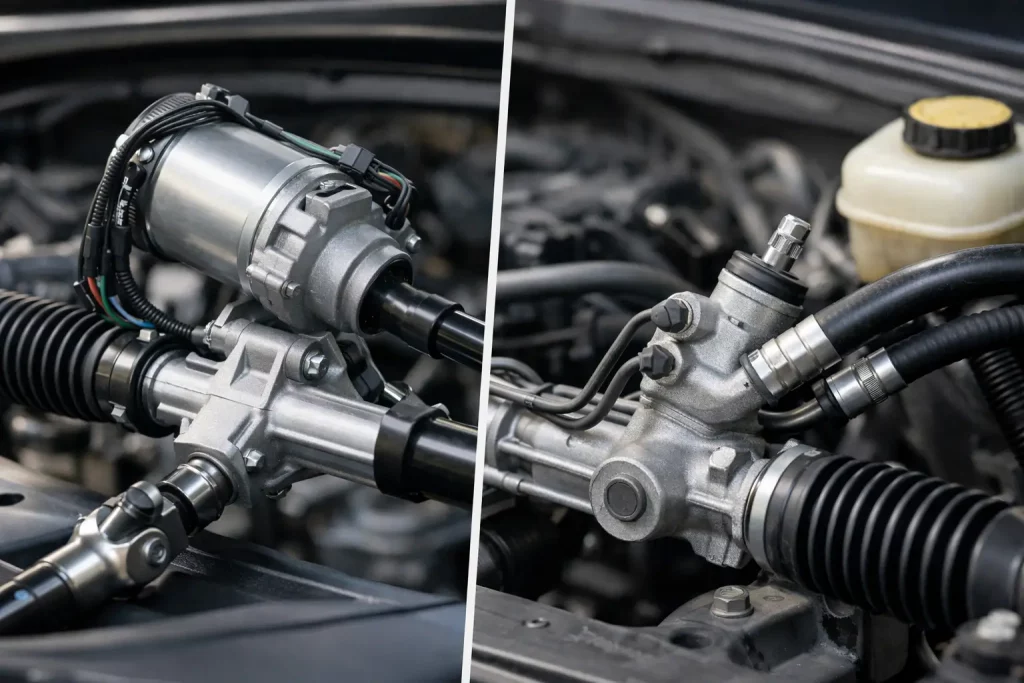
A steering fault is rarely just a question of whether the wheel feels heavy. The difference between electric versus hydraulic steering affects the way a vehicle responds, the faults it develops and the correct route to repair. On a modern premium car, an EPS warning message or intermittent assistance may point towards electronics, software or internal rack wear. On an older vehicle, stiff or inconsistent steering can originate in the hydraulic system, the rack itself or mechanical parts around it.
Both systems can provide safe, accurate and confidence-inspiring steering when operating correctly. Neither is automatically better in every application. The right diagnosis starts with identifying the system fitted, understanding how it should behave for that particular vehicle and testing the components before replacing expensive parts.
Electric versus hydraulic steering: the core difference
Hydraulic power steering uses fluid pressure to reduce the effort required at the steering wheel. A belt-driven pump, or occasionally an electro-hydraulic pump, supplies pressurised fluid to a steering rack or steering box. When the driver turns the wheel, a control valve directs that pressure to assist the movement.
Electric power steering, generally referred to as EPS, uses an electric motor and a control module instead. The motor may be mounted on the steering column, the pinion or directly on the rack. Sensors monitor steering input and vehicle data, and the module calculates how much assistance to apply.
That distinction changes the way each system is diagnosed. A hydraulic system needs assessment of pressure, fluid condition, leaks, internal rack condition and mechanical steering resistance. EPS requires electrical and electronic checks alongside mechanical inspection. Fault codes are useful, but they do not always identify the failed component on their own.
How hydraulic steering feels and where it suits
Hydraulic assistance has been used for decades because it offers consistent, strong assistance and a naturally connected steering feel. It remains common on older cars, classics, larger vehicles and many performance applications. A properly operating hydraulic rack can give excellent feedback through the steering wheel, particularly as cornering loads build.
The system is also comparatively straightforward in principle. The rack, pump, valve and associated components are separate serviceable items on many vehicles. For suitable units, a specialist can assess wear at component level rather than assuming a complete assembly is required.
Its limitations are largely mechanical. A conventional engine-driven pump consumes power whenever the engine is running, whether steering assistance is needed or not. The system also relies on correctly maintained fluid, sound seals and a rack that is free from internal corrosion or wear. Leaks, noise, uneven assistance and heavy steering can all develop gradually, so drivers may not notice the loss of steering quality until it becomes significant.
Hydraulic steering faults can also be confused with unrelated problems. A binding lower steering shaft, worn suspension joint, incorrect wheel alignment or seized top mount can make a healthy rack feel heavy. Replacing a rack without investigating those factors risks leaving the original complaint unresolved.
Common hydraulic steering symptoms
A groan on full lock, fluid loss, an oily rack gaiter or assistance that changes from one direction to the other needs proper inspection. So does free play around the straight-ahead position, a steering wheel that fails to return correctly, or a notchy feel during slow manoeuvres.
The repair solution depends on the findings. Some racks and steering boxes can be reconditioned with appropriate OE or OE-quality internal parts, then tested before dispatch. Others may be too damaged, unavailable in suitable repairable condition or uneconomical to rebuild. In those cases, replacement may be the sensible route.
What electric power steering changes
EPS removes the continuous hydraulic load from the engine and allows assistance to be varied far more precisely. At parking speeds, the system can provide substantial help. At higher speeds, it can reduce assistance to support stable, controlled steering. This contributes to fuel-efficiency and emissions targets, but it also gives manufacturers greater scope to tailor steering weight and response for a specific model.
Electric systems also support functions that hydraulic steering cannot easily provide. Depending on the vehicle, EPS may work with lane assistance, parking functions, driver-selectable steering modes and stability-control systems. These features are useful, but they mean the steering system is no longer only a mechanical assembly.
For the driver, EPS can feel lighter and more consistent in day-to-day use. However, steering feel varies widely by manufacturer and calibration. Some enthusiasts prefer the loaded, hydraulic feel of certain older sports cars, while others value the low-speed ease and adaptable assistance of a modern electric rack. Vehicle purpose matters more than broad claims about one system being superior.
EPS faults are not always motor faults
An EPS warning light, loss of assistance or intermittent heavy steering may be caused by a failed motor, torque sensor, internal control module, damaged wiring, low system voltage, communication faults or mechanical wear inside the rack. A weak battery or charging issue can sometimes create steering-related fault messages, particularly on vehicles that are sensitive to voltage drops.
This is why a code reader alone is not a full diagnosis. Live data, supply and earth checks, network communication, steering angle information and the physical condition of the rack all need consideration. The vehicle may also require coding, calibration or an alignment procedure after repairs, depending on the make and model.
For applicable EPS racks, Pro Power Steering can assess suitable units for component-level repair and may flash or virginise them in preparation for vehicle-specific coding and calibration. This can be a practical alternative to replacing a complete unit unnecessarily, but compatibility and vehicle requirements must be confirmed first.
Repair, reconditioning or replacement?
The most cost-effective option is not automatically the cheapest part on paper. It is the repair that accurately addresses the fault, suits the vehicle and can be fitted and commissioned correctly.
Reconditioning can be appropriate where a steering rack, box or related component is structurally sound and has a known repairable fault. The unit should be stripped, inspected, rebuilt with suitable parts where applicable and tested. This approach is particularly valuable for hard-to-source Right Hand Drive racks, classic components and specialist applications where direct replacement choices may be limited.
Complete replacement remains necessary in some circumstances. Severe accident damage, major corrosion, unavailable electronics, an unsuitable core unit or manufacturer restrictions may rule out reconditioning. Certain EPS systems may also require dealer-level programming or calibration equipment after fitting. A professional assessment should be clear about these limits rather than promising that every steering unit can be repaired.
Fitting quality matters just as much as the unit supplied. A rack installed with a steering wheel off-centre, a disturbed steering angle sensor or incorrect toe settings can create new faults and poor handling. Once the steering system has been disturbed, correct alignment and any required calibration should be treated as part of completing the repair, not an optional extra.
Choosing the right system for a classic or conversion
For an original classic car, retaining hydraulic steering may be the right choice where originality, period driving character and existing component availability matter. A correctly rebuilt system can preserve the intended feel while reducing unwanted play, leaks or inconsistency.
Electric assistance can be attractive for selected classics and specialist vehicles where low-speed steering effort is excessive. A properly designed conversion can make parking and manoeuvring easier without making the vehicle vague or unpredictable. The design, installation position, steering geometry and calibration all matter. It should be approached as a steering-engineering decision, not as a universal modification.
For modern vehicles, the choice has normally already been made by the manufacturer. The priority is restoring the fitted system to smooth, precise and safe operation using the correct diagnostic and repair process.
The practical decision
Hydraulic steering remains valued for its feel, mechanical simplicity and suitability for many older, commercial and specialist vehicles. EPS brings efficiency, adaptable assistance and integration with modern vehicle systems, but demands more careful electronic diagnosis and often post-repair coding or calibration.
If the steering is heavy, noisy, leaking, inconsistent or showing an EPS warning, avoid assuming the rack is the only possible cause. A focused steering diagnosis can identify whether the issue lies in the rack, column, shaft, electronics, alignment or another connected component. The best result is not simply lighter steering – it is steering that is smooth, precise and predictable every time the vehicle is used.
