
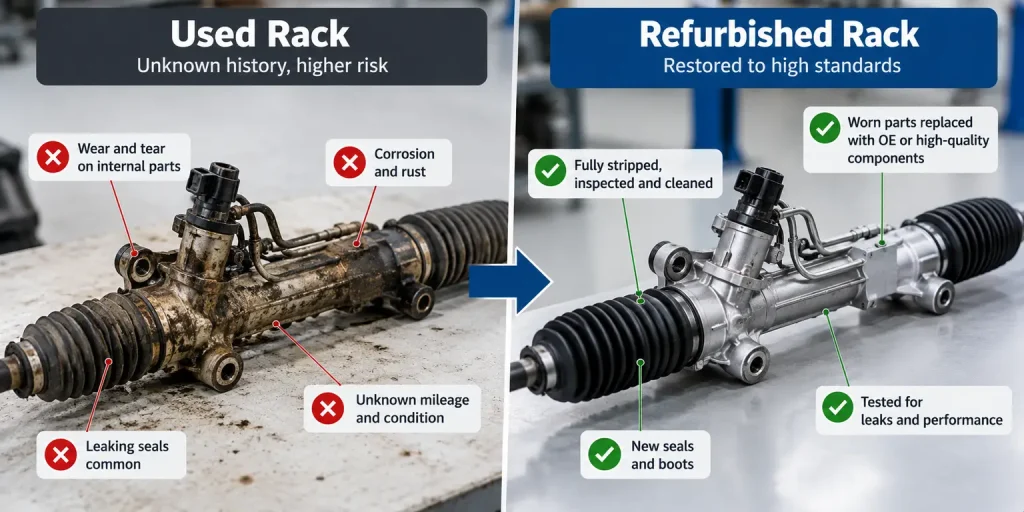
A steering rack may look like a straightforward replacement part, but the difference between a refurbished rack versus used rack can affect far more than the invoice total. It can determine whether the vehicle returns to smooth, accurate steering or develops leaks, warning lights, uneven assistance or unwanted play shortly after fitting. For garages and owners alike, the right choice starts with knowing the unit’s condition, provenance and vehicle-specific requirements.
Refurbished rack versus used rack: the core difference
A used steering rack is normally removed from another vehicle and sold in the condition in which it was recovered. It may have come from a low-mileage vehicle, but mileage alone does not reveal how it has been driven, stored or handled. The donor vehicle may have had collision damage, corrosion, a steering fault or an undisclosed issue that did not become apparent before removal.
A refurbished, or reconditioned, rack is different. A suitable original unit is stripped, assessed and rebuilt at component level. Worn or damaged internal parts are identified, with seals, bearings, bushes and other serviceable components replaced where required. The completed rack is then tested before leaving the workshop.
That distinction matters because a steering rack is not simply a casing with a pinion attached. Hydraulic racks rely on internal sealing and precise operation under pressure. Electric power steering, or EPS, racks combine mechanical steering components with motors, sensors and electronic control systems. A rack can appear clean externally while having internal wear or electrical faults that only show under operating conditions.
Why condition cannot be judged by appearance
A used rack may be advertised as tested, but the wording can mean very different things. It may only mean that the donor vehicle moved under its own power, that the rack turned lock to lock when removed, or that a basic visual inspection was carried out. None of these checks necessarily proves that the rack is free from internal leakage, excessive backlash, sensor faults or intermittent EPS issues.
External condition can also be misleading. Fresh paint, new gaiters or a cleaned housing do not confirm the state of the rack bar, pinion, seals or electronic parts. Corrosion on the exposed rack bar, for example, can damage new seals and lead to fluid loss once the unit is put back into service. Wear within the pinion mechanism can contribute to a vague steering feel, knocking or poor straight-ahead control.
A professionally reconditioned unit should be assessed according to its design and reported fault. Not every rack is a candidate for repair. A severely damaged housing, an unavailable electronic component or extensive corrosion may make complete replacement the more sensible option. Honest assessment is part of choosing a reliable repair route, rather than assuming reconditioning is always possible.
The value of component-level reconditioning
The purpose of reconditioning is not merely to make a rack presentable. It is to address the cause of the fault where practical. On a hydraulic rack, that may involve correcting internal seal failure, wear or damage affecting operation. On an EPS unit, diagnosis may extend to the motor, torque sensor, ECU communication and position-related faults, depending on the application.
Suitable rebuilt racks are tested to confirm their operation before supply. This gives the fitting garage or owner a much clearer basis for installation than an unverified donor part. It also helps prevent the false economy of paying for removal and refitting twice when a used unit proves defective.
When a used rack can be a reasonable choice
There are circumstances where a used rack may be considered. A genuinely traceable, low-mileage donor unit can be relevant for an older vehicle where reconditioning parts are unavailable, or for a specialist model with limited component supply. For some classic applications, a sound original unit may be the only realistic starting point.
Even then, it is worth treating the purchase as a calculated risk rather than an equivalent alternative to a rebuilt rack. Ask whether the exact part number has been checked, whether the rack came from a right-hand-drive vehicle where applicable, and what testing has actually been completed. Confirm the supplier’s warranty terms, including whether labour, diagnostics or removal costs are excluded.
Compatibility is especially important on modern vehicles. Two racks that look similar can differ in mounting points, steering ratio, inner joint arrangement, connector type, software configuration or sensor specification. The correct vehicle identification number, original part number and equipment level should be used to establish suitability. A rack from a left-hand-drive donor is not automatically suitable for a right-hand-drive car.
EPS racks need more than a mechanical match
Electric steering systems add another layer to the decision. An EPS rack can be mechanically sound but still unsuitable if it carries fault codes, is configured for a different vehicle specification or requires coding after installation. Depending on the make and model, the replacement unit may need flashing, virginising, programming or calibration before the vehicle will recognise it correctly.
This is why an apparent bargain can become expensive. A used EPS rack may arrive with the donor car’s stored data, an incompatible module or an intermittent electronic fault. A refurbished EPS unit may need preparation for the recipient vehicle as well, but the requirement can be identified before fitting rather than discovered after the steering warning light remains on.
The vehicle may also require steering-angle sensor calibration, end-stop learning or ADAS-related procedures following rack replacement. Wheel alignment is normally essential after steering work. Where systems such as lane assistance rely on accurate steering-angle information, proper calibration is a safety and drivability requirement, not an optional extra.
Cost should include the fitting risk
The purchase price is only one part of the comparison. Replacing a steering rack involves labour, alignment and, on many vehicles, diagnostic work and coding. If a used rack fails early or proves incompatible, those costs can be incurred again. For a business managing fleet uptime, or a garage responsible for a customer repair, that exposure can outweigh the initial saving.
A reconditioned rack generally costs more than an untested used unit because assessment, parts, specialist labour and testing are included. In return, the buyer should have a defined level of confidence in the unit and a clear warranty position. Pro Power Steering supports completed steering work with a 12-month warranty under the applicable terms, while providing technical guidance where a fitting garage needs it.
The decision is not simply new versus old. A new rack may be the correct route where the vehicle manufacturer specifies it, where an electronic unit cannot be reliably repaired, or where a remanufactured alternative is unavailable. Conversely, a correctly reconditioned original rack can be a practical and cost-effective choice when it has been professionally assessed and tested.
Questions to settle before ordering
Before authorising a rack replacement, establish the actual fault. Heavy steering, a leak, a knock, poor self-centring and an EPS warning light do not all point to the rack itself. Related issues can include steering columns, shafts, joints, wiring, low system voltage, suspension wear or calibration faults. Accurate steering diagnostics reduce the chance of fitting a replacement component unnecessarily.
Once a rack has been confirmed as the cause, the following points should be clear between the customer, garage and supplier:
- Is the rack definitely correct for the vehicle’s registration, VIN, original part number and right-hand-drive configuration?
- Has the replacement been tested, and what does that testing cover?
- Does the vehicle require coding, flashing, virginising or calibration after installation?
- Are new pipes, seals, fasteners or associated steering components required during fitting?
- What warranty applies, and are there conditions relating to installation, fluid contamination or diagnostic procedures?
These questions are particularly valuable for premium, performance and commercial vehicles, where steering variants can be numerous and the consequences of an incorrect unit are more costly.
Choose certainty where the repair demands it
A used rack can have a place when availability is limited and its origin is genuinely known. But for most repairs, a professionally reconditioned and tested rack offers a more controlled route, particularly where steering precision, electronic compatibility and repeat labour costs matter.
The most useful next step is not to choose from a photograph or price alone. Confirm the fault, identify the exact rack specification and establish what the vehicle will need after fitting. That approach gives the repair the best chance of restoring the safe, smooth and precise steering the vehicle was designed to deliver.
