
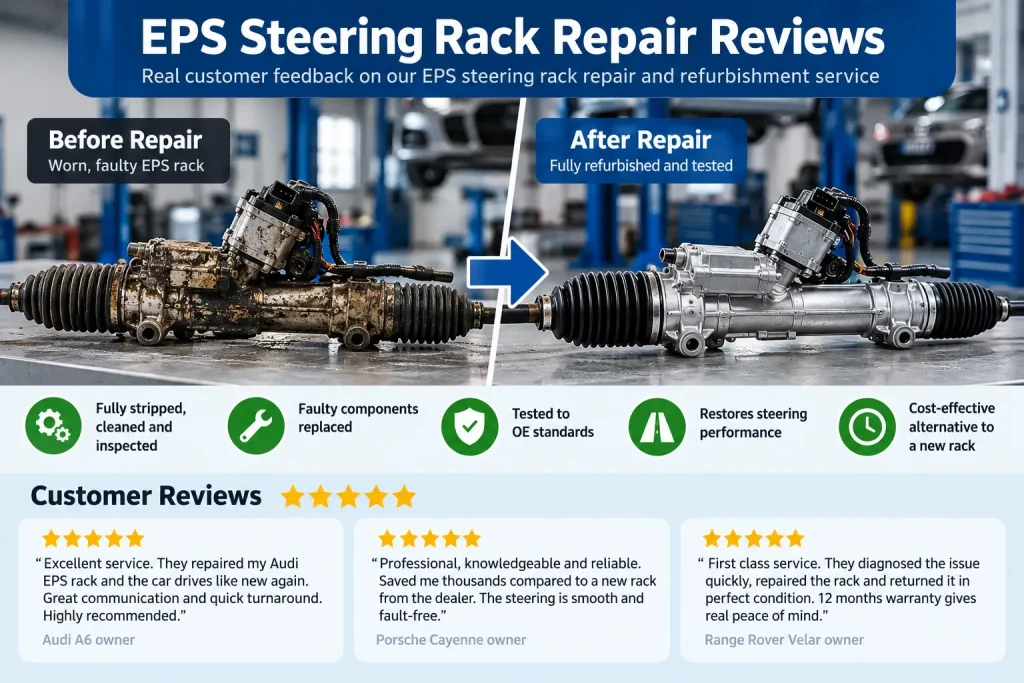
A warning light, intermittent loss of assistance or a steering wheel that suddenly feels heavier can make an EPS repair feel urgent. That is why EPS repair reviews are often one of the first places drivers and garages look before choosing a specialist. The useful reviews, however, are rarely the shortest or most enthusiastic. They describe the vehicle, the fault, the diagnostic process and what happened after the repair.
Electric power steering is not simply a mechanical rack with a motor attached. On many vehicles, it is a safety-critical system combining steering mechanics, sensors, an electric motor, an electronic control unit and vehicle-network communication. A review should therefore help you judge whether a business understands the complete system, rather than whether it was merely able to supply a replacement part.
What EPS repair reviews should tell you
The most credible feedback normally contains enough detail to show that the original fault was investigated properly. A customer may refer to a heavy steering complaint, an EPS warning message, a loss of assistance when hot, a pull after repair or a persistent fault code. Those symptoms can point in several directions, and the best reviews reflect that rather than presenting every job as a quick, identical fix.
For example, an EPS warning lamp does not automatically mean the rack has failed. The cause may be within the motor or torque sensor, but it may also involve low system voltage, charging faults, damaged wiring, a poor earth, water ingress, a steering-angle issue or a communication fault elsewhere on the vehicle. Mechanical wear in the rack, column joints or suspension can also affect steering feel without being the source of an electronic warning.
Look for comments that mention diagnostic checks before parts were authorised. A specialist should be able to assess fault codes alongside live data, electrical supply and earth integrity, network communication and the mechanical condition of the steering system. The precise process varies by manufacturer and model, but the principle remains the same: repair decisions should be based on evidence, not solely on a dashboard message.
A useful review may also mention that the customer was advised when repair was not the right route. Not every EPS unit is economically viable to recondition, and some damage or electronic failures may require a replacement assembly. Honest limitations are a positive sign. They suggest the workshop is choosing the appropriate remedy for the condition of that specific unit.
Read beyond star ratings
A five-star rating is encouraging, but it is only the start of the assessment. Review platforms can be valuable for identifying patterns in communication, turnaround, technical knowledge and aftercare. They are less useful when every comment is vague or when the same wording appears repeatedly.
Pay attention to whether reviews cover different types of customers. A vehicle owner may value a clear explanation and predictable collection arrangements. An independent garage may focus on accurate identification, a tested unit, parts availability and responsive technical support during fitting. Fleet operators may need dependable turnaround and a repair that returns a vehicle to service without unnecessary replacement cost.
The strongest patterns are often practical rather than dramatic. Customers may mention that the right questions were asked before the rack was removed, that a unit was matched correctly to the vehicle, or that coding requirements were explained in advance. Those details matter because EPS applications can differ by model year, steering variant, vehicle specification and software configuration.
It is also worth reading the less positive feedback carefully. A delayed repair is not automatically poor service if a rare component, specialist testing or manufacturer-specific information was required. What matters is whether the customer was kept informed, whether the explanation was technically plausible and whether the business dealt with the issue properly. Steering repairs occasionally reveal further faults outside the original component, particularly on older or high-mileage vehicles.
Specificity is more valuable than sales language
Reviews that state only “great service” or “saved me money” can be genuine, but they do not tell you much about repair quality. Greater confidence comes from feedback that describes a measurable outcome: smooth, consistent assistance; no return of the warning light; correct steering-centre position after alignment; or successful programming and calibration following refitting.
That does not mean every reviewer needs to use technical language. Many drivers should not be expected to know whether their vehicle uses a column-mounted motor or rack-mounted assistance. The point is that the outcome should be clear, and the repairer’s explanation should make sense for the work carried out.
Questions reviews cannot answer on their own
Even excellent reviews cannot confirm that a particular EPS rack can be repaired. The unit must first be identified and assessed. Part numbers, vehicle registration details, chassis information and a description of the fault can all help establish the correct path, but workshop inspection may still be necessary.
Nor can reviews remove the need for vehicle-side checks after installation. Depending on the application, an EPS rack may need software flashing or virginising before vehicle-specific coding. Steering-angle sensor calibration may be required, and wheel alignment should be checked whenever steering or suspension geometry has been disturbed. A rack that is electrically sound can still leave the vehicle feeling wrong if these final procedures are missed.
Before committing to a repair, ask what is included in the quoted work. Clarify whether the price covers diagnosis, removal and refitting, coding, calibration, alignment or collection and delivery. For supply-only work, establish what information the fitting garage will need and whether technical advice is available if an installation issue arises.
For many suitable units, a component-level reconditioning route can be a sensible alternative to replacing the complete assembly. It can retain the original housing and vehicle-specific fitment while addressing confirmed internal faults with appropriate OE or OE-quality components where applicable. However, this approach depends on the unit’s condition, available parts and the nature of the failure. It should not be presented as a universal answer.
Signs of a well-managed EPS repair
A reliable repair process normally starts before the component reaches the bench. The symptoms, scan results and vehicle details help separate likely rack faults from faults in the power supply, network or associated steering components. Once the unit is removed, its condition can be assessed for mechanical wear, contamination, corrosion, damaged connections and internal electronic or sensor-related issues.
Where repair is appropriate, the goal is not simply to make a warning light disappear. The unit should be rebuilt carefully, checked for correct operation and tested before it leaves the workshop. The exact test procedure depends on the design, but a specialist should be able to explain how the unit has been evaluated and what preparation is required before it is fitted back to the vehicle.
For applicable models, flashing or virginising may be part of preparing the rack for the car. This is particularly relevant where the replacement or repaired unit needs to accept the vehicle’s own configuration during coding. A review that refers to successful post-fit calibration is valuable because it recognises that the repair is not complete until steering assistance, warning status and vehicle geometry are all properly verified.
Pro Power Steering approaches EPS work as a specialist engineering and reconditioning task, with direct technical support available to customers and fitting garages where required. Completed applicable work is supported by a 12-month warranty under the relevant terms, but warranty should never replace correct diagnosis, fitting and calibration.
Use reviews to start the right conversation
The best use of EPS repair reviews is to narrow down businesses that appear methodical, transparent and experienced with your vehicle type. Then provide a clear account of the symptoms: when they occur, whether the warning lamp is permanent or intermittent, recent battery or charging issues, accident damage, water exposure and any scan results already recorded. A garage should also mention previous steering or suspension work, as that context can be relevant to calibration and alignment.
A convincing repairer will not promise a result before the fault has been established. They will explain the likely options, the information needed and any work that may still be required after installation. That is particularly valuable with premium, performance, commercial and Right Hand Drive applications, where the wrong steering unit or incomplete programming can create avoidable delays.
Choose reviews that show careful diagnosis and a properly finished repair, not just a quick part exchange. Smooth, precise steering begins with finding the real fault and following the correct route all the way through to coding, calibration and final road-ready checks.
