
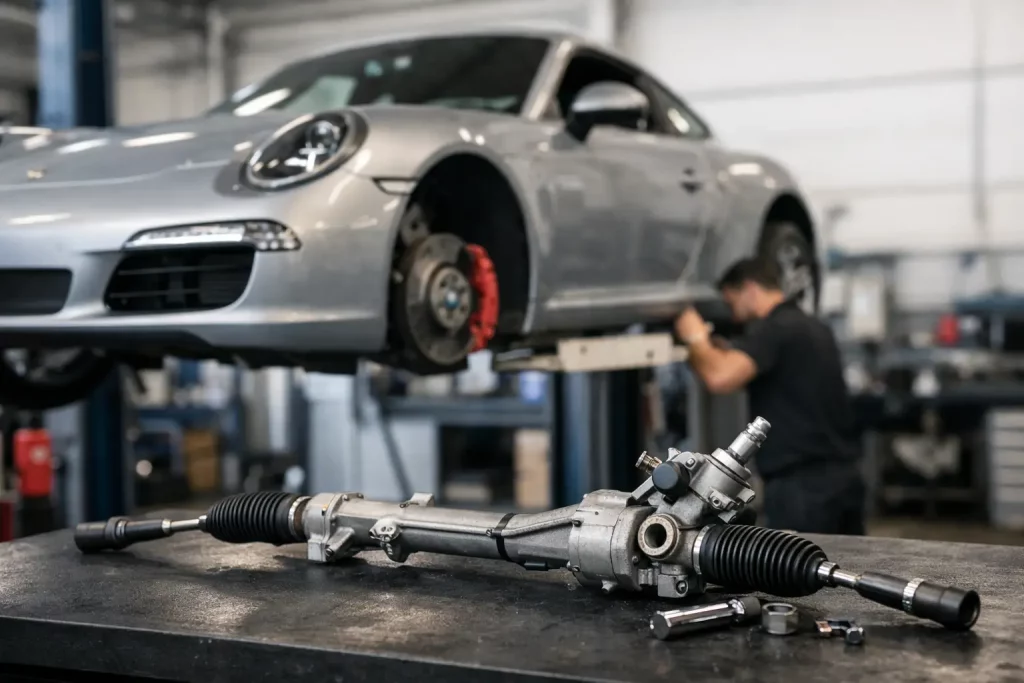
A Porsche 911 should feel settled and accurate through the wheel, whether it is manoeuvring at low speed or loaded through a fast, flowing bend. When the steering becomes heavy, vague, notchy or inconsistent, the fault is not always obvious from the driver’s seat. A Porsche 911 steering rack can develop mechanical, hydraulic or electronic faults depending on the generation, and identifying the cause correctly matters before any parts are ordered.
The right repair can preserve the steering character that makes a 911 rewarding to drive. The wrong diagnosis can mean replacing an expensive assembly when the underlying issue lies elsewhere in the steering system, suspension geometry or vehicle electronics.
Porsche 911 steering rack systems by generation
The 911 has used several very different steering arrangements over its long production life. Earlier air-cooled cars generally use a manual rack-and-pinion arrangement, while later models introduced hydraulic power assistance. Modern 911s, including the 991 and 992 generations, use electrically assisted power steering, commonly referred to as EPS.
That distinction changes both the symptoms and the repair path. A hydraulic rack has internal seals, fluid passages and a control valve that may wear or leak. An EPS rack incorporates an electric motor, torque sensing and control electronics, so a warning message or variable steering assistance may be as relevant as a mechanical noise.
Even within one model generation, specification matters. Carrera, Turbo, GT and four-wheel-drive versions can have different rack ratios, mountings, part numbers and electronic configurations. Right Hand Drive racks are also not simply interchangeable with Left Hand Drive units. The pinion position, pipe layout, housing arrangement and steering-column connection can differ, so accurate vehicle identification is essential.
Symptoms that warrant steering diagnosis
A steering rack fault does not always announce itself as a dramatic failure. More often, it begins as a small change in feel: a tight spot near the straight-ahead position, a delay before the car responds, or an uneven weight through the steering wheel. On a car as communicative as a 911, those changes are worth investigating promptly.
Hydraulic 911s may show fluid loss, dampness around the rack gaiters or evidence of fluid on the undertrays. If fluid has entered a gaiter, it can indicate an internal rack seal issue, although the full system still needs assessment before the rack is condemned. Steering that is heavy in one direction, or assistance that changes as the wheel is turned, may point towards an internal hydraulic fault but can also be influenced by related components.
On EPS-equipped models, drivers may experience intermittent heaviness, reduced assistance, steering warning lights or fault codes stored in the vehicle. A rack may be mechanically sound while the problem relates to its motor, torque sensor, wiring, supply voltage or software configuration. Conversely, a warning light does not prove that an electronic module alone is at fault.
Knocking, wandering or imprecise turn-in should also be treated carefully. Inner joints, track rod ends, column joints, suspension bushes, top mounts and wheel alignment can all affect steering feel. A rack diagnosis should therefore consider the whole steering path rather than relying on one symptom.
Why accurate diagnosis saves time and unnecessary replacement
The steering rack is central to the system, but it is not isolated from it. Before deciding on repair, reconditioning or replacement, a specialist will assess the reported symptoms alongside physical inspection and, where appropriate, diagnostic equipment. For hydraulic systems, this may include checking rack movement, external leakage, mounting condition and the operation of associated components. For EPS systems, fault-code interrogation and live data can help establish whether the rack is receiving the correct inputs and electrical supply.
The vehicle’s history is useful too. A recent kerb strike, accident repair, suspension work or flat battery can change the direction of investigation. A steering wheel that sits off-centre following alignment work may need geometry correction, whereas an EPS warning following low voltage may require electronic diagnosis and calibration checks before a rack is removed.
This approach also protects garages and owners from a common problem: fitting a replacement unit that does not cure the original complaint. It is particularly relevant on modern Porsche models, where fitting, coding, calibration and alignment may all form part of returning the vehicle to proper operation.
Repair, reconditioning or replacement?
A reconditioned Porsche rack can be a sensible option where the original unit is suitable for component-level repair. The rack is stripped, assessed for wear or damage, rebuilt with appropriate OE or OE-quality service parts where applicable, then tested before release. This can address serviceable internal faults while retaining the correct application-specific housing and configuration.
However, not every rack can or should be rebuilt. Severe corrosion, damaged castings, accident damage, worn hard parts beyond acceptable limits, unavailable components or non-serviceable electronic failures may make replacement the appropriate route. The condition of the individual unit, rather than its age alone, should guide the decision.
For classic and older 911 applications, retaining the original rack can be particularly valuable where replacement units are scarce or where correct fitment matters to a restoration. For later hydraulic cars, reconditioning can avoid the uncertainty of using an unverified second-hand rack. On EPS models, the technical requirements are different again: a supplied rack may need to be flashed or virginised where applicable, then coded and calibrated to the vehicle once fitted.
There are trade-offs. Reconditioning is dependent on the unit being suitable and on parts availability. A new replacement may be necessary in some cases, and dealer involvement can be required where manufacturer-level programming access or vehicle-specific procedures apply. An honest assessment should set this out before work begins.
What fitting work should include
A correctly repaired or replaced steering rack still needs correct installation to deliver the result the driver expects. The rack must be centred, the steering wheel position checked and all relevant fixings tightened to the manufacturer’s specification. Any disturbed joints, gaiters or steering-column connections need careful inspection during refitting.
Wheel alignment is not an optional finishing touch after rack work. Removing and refitting a rack or adjusting track rods changes the relationship between the wheels and steering wheel. A proper alignment check helps prevent tyre wear, off-centre steering and poor straight-line stability. On performance models, geometry should be set to the appropriate vehicle specification and usage requirement, not merely adjusted until the wheel looks straight.
EPS-equipped 911s may also require steering-angle sensor calibration, end-stop learning or vehicle-specific coding following repairs. The exact process depends on the model and the work carried out. Skipping these procedures can leave warning messages, altered assistance or system faults even when the mechanical installation is correct.
A specialist approach for Right Hand Drive 911s
Porsche steering parts are often listed by broad model range, but that is not enough to guarantee suitability. Part number, model year, engine variant, drive configuration, rack type and hand of drive should be verified. This is especially important for UK vehicles, where a Right Hand Drive rack may not match a readily available Left Hand Drive unit despite appearing similar in photographs or general catalogue descriptions.
For owners and workshops, clear information at the start helps avoid delay. The registration number, VIN, part number from the rack where visible, precise symptoms and any diagnostic fault codes provide a useful basis for assessment. If the rack has already been removed, protecting the input shaft, ports and electrical connectors during transport is equally important.
Pro Power Steering assesses suitable steering units at component level and supports repair, reconditioning, supply and fitting requirements across hydraulic, manual and electric systems. Completed eligible work is supported by a 12-month warranty under the applicable terms, with direct technical guidance available for fitting garages where needed.
A 911 steering concern is best addressed when it first appears, before a minor inconsistency becomes a loss of confidence in the car. The aim is not simply lighter steering or a cleared warning light, but a system that returns the precise, predictable response the vehicle was engineered to provide.
