
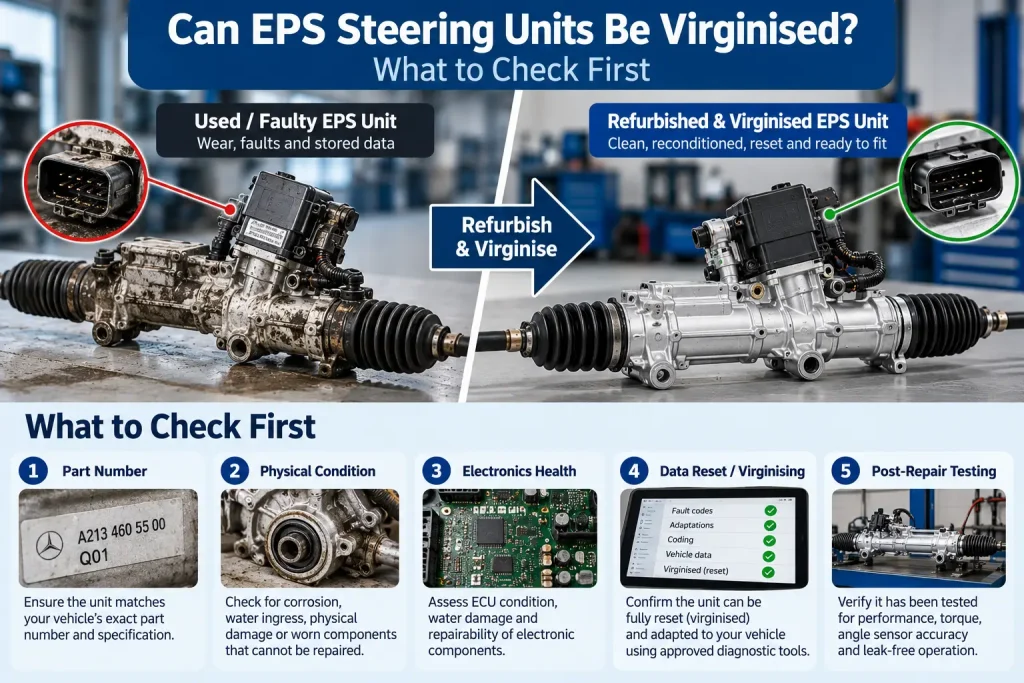
An EPS steering rack warning light following a steering rack or column replacement can leave a perfectly serviceable unit looking like a failed one. The short answer to can EPS units be virginised is: sometimes, but not in every case. Whether it is possible depends on the vehicle, the type of electric power steering system, the module software, and why the unit is being fitted.
Virginisation is not a substitute for proper diagnosis or mechanical repair. It is a programming process used on certain applicable units to prepare the electronic control module for coding and calibration in another vehicle. The steering assembly must still be mechanically sound, correctly fitted and compatible with the vehicle.
What virginising an EPS unit actually means
Most modern electric power steering systems contain an ECU within the steering rack, steering column or a separate control module. That ECU may store vehicle-specific information, such as coding, configuration data, calibration values and, on some applications, a vehicle identification reference.
When a replacement or reconditioned unit is installed, the vehicle may reject it if the stored information does not match what the car expects. This can result in warning messages, fault codes, reduced steering assistance or no assistance at all.
Virginising generally means resetting or preparing compatible module software so the EPS unit can accept the coding required by its new vehicle. Depending on the application, this may involve flashing the unit with appropriate software, clearing configuration data or returning the module to a state where vehicle-specific commissioning can be completed.
It does not mean every stored fault is simply erased, and it does not bypass the need for authorised diagnostic procedures. A properly prepared EPS unit still needs the right vehicle coding, calibration routines and post-repair checks.
Can EPS units be virginised on every vehicle?
No. EPS systems vary considerably between manufacturers, model ranges and even production years. Two steering racks that look identical may have different part numbers, communication protocols, motor specifications, torque sensor arrangements or software versions.
Some modules can be reset and subsequently coded to the vehicle. Others are locked to their original configuration, require manufacturer-level online programming, or cannot be reused reliably outside their original vehicle. In those cases, a new replacement unit, a correctly supplied programmed unit, or a module cloning solution may be the appropriate route.
Security architecture also matters. On newer vehicles, the steering module can be part of a wider network involving the body control module, gateway, immobiliser or driver-assistance systems. If the module is security-protected, coding may require access to approved manufacturer systems. Trying to treat this as a simple plug-in repair can create further faults and unnecessary delay.
For that reason, the correct answer begins with the exact vehicle registration, VIN, original steering part number and diagnostic fault information. A specialist can then assess whether the unit is suitable for repair, reconditioning, virginisation, cloning or replacement.
Why a virginised unit may still need coding and calibration
Virginisation prepares an applicable unit. It does not complete the job.
After fitting, the vehicle may need configuration coding so the EPS ECU knows which vehicle it is installed in and which steering characteristics apply. The workshop may then need to carry out steering angle sensor calibration, torque sensor or centre-position learning, end-stop learning and fault-code clearing, where specified by the manufacturer.
On vehicles with lane assist, parking assist, adaptive lighting or other driver-assistance functions, accurate steering angle information is especially important. A steering system that has not been commissioned correctly may feel normal at low speed yet still generate dashboard warnings or disable related safety systems.
Wheel alignment is equally relevant. If a rack has been removed and refitted, or if track rod settings have been disturbed, a full alignment check should form part of the repair process. Coding cannot correct incorrect toe settings, an off-centre steering wheel or worn suspension components.
Virginising is not the same as repairing an EPS fault
Electronic configuration issues are only one possible cause of EPS trouble. Heavy steering, intermittent assistance, warning lights and steering pull can all have different origins. A low battery voltage, poor earth connection, damaged wiring, communication fault, failed torque sensor, worn rack mechanism or internal motor problem can produce similar symptoms.
This is why fitting a used rack without diagnosis is often a false economy. The replacement unit may not cure the original fault, and it may introduce coding complications at the same time. Equally, replacing a complete EPS assembly when the fault lies in a wiring connection or related vehicle system can be unnecessary.
A suitable specialist assessment considers both sides of the system: the mechanical condition of the rack or column, and the electronic information required for it to operate in the vehicle. Diagnostic fault codes are useful, but they must be interpreted alongside live data, supply voltage checks and the vehicle’s symptoms.
When reconditioning and virginisation make sense
For many vehicles, reconditioning an original steering unit can avoid compatibility issues because the correct vehicle-specific electronics remain with the car. Where a unit is suitable, component-level repair may address internal wear or electrical faults without automatically replacing the whole assembly.
A reconditioned replacement can also be a practical option when the original unit is beyond repair or unavailable. If the model supports it, flashing or virginising the replacement EPS unit can prepare it for the fitting garage to code and calibrate it correctly.
This approach is particularly valuable for garages dealing with premium, specialist or Right Hand Drive applications, where the exact rack specification matters. Rack travel, mounting points, pinion position, motor location and software specification must all be correct. A left-hand-drive unit is not automatically an acceptable substitute for a right-hand-drive vehicle simply because it appears similar.
At Pro Power Steering, suitable EPS units are assessed at component level, rebuilt using appropriate OE or OE-quality parts where applicable, and tested before leaving the workshop. For applicable models, units can also be prepared for vehicle-specific coding and calibration. The appropriate route is always determined by the unit and vehicle, rather than assuming that every EPS assembly can be virginised.
Information a workshop should check before fitting
Before ordering or fitting an EPS rack or column, the workshop should confirm the original equipment part number and all suffixes, not just the vehicle make and model. The VIN, engine and transmission type, model year, steering system type and presence of driver-assistance equipment may all affect compatibility.
It is also sensible to record the original fault codes before disconnecting the old unit. This creates a clearer starting point if faults remain after installation. Battery condition should be checked too. Programming and calibration with unstable voltage can fail or produce misleading communications faults.
Once fitted, the mechanical installation deserves the same care as the electronics. The steering wheel should be centred, the intermediate shaft connected correctly, fasteners tightened to the manufacturer’s specification and the track rod ends set before alignment. The vehicle should then undergo the required diagnostic routines and a controlled road test to confirm smooth, precise assistance with no warnings.
The practical answer for owners and garages
An EPS unit can sometimes be virginised, but it is not a universal service and should never be assumed from the term alone. The viable repair path may be reconditioning the original unit, virginising and coding a compatible replacement, cloning approved data where appropriate, or fitting a new unit that is commissioned through the manufacturer process.
The best outcome comes from establishing the fault first, checking exact compatibility and planning the coding and calibration before the vehicle is dismantled. That approach protects the driver from repeat repairs and gives the fitting workshop a far better chance of returning the steering to the smooth, safe and accurate operation the vehicle was designed to deliver.
