
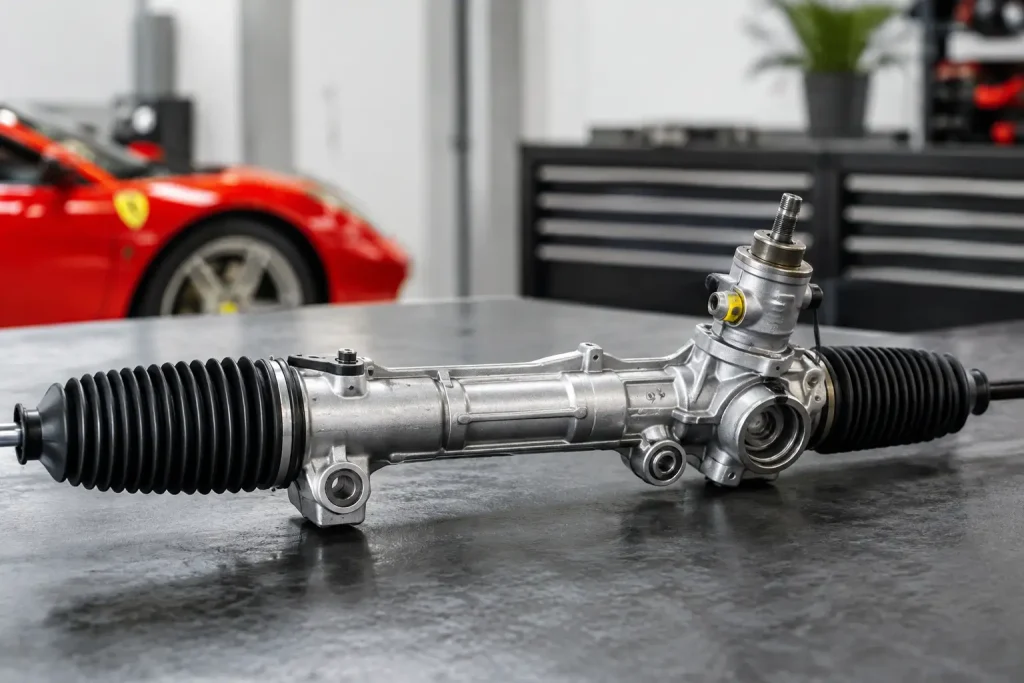
A Ferrari that no longer tracks cleanly, feels unexpectedly heavy at low speed or has lost its crisp steering response needs more than a replacement part quoted from a catalogue. Ferrari steering restoration is about returning the entire steering system to the character intended for the car: controlled weight, accurate self-centring and clear feedback without vibration, noise or unwanted play.
For a road car, grand tourer or classic Ferrari, those qualities affect confidence as much as comfort. The correct repair path depends on the vehicle’s age, steering design, condition and history. A specialist assessment separates a repairable component fault from wear elsewhere in the system, preventing expensive work that does not address the real cause.
Why Ferrari steering restoration needs a measured approach
Ferrari steering systems have changed considerably over the decades. Earlier cars may use manual racks or hydraulic assistance, while later models can combine more complex hydraulic arrangements, electronically controlled assistance and vehicle-specific control systems. The badge alone does not define the repair. The rack, column, pump where fitted, electronic controls, suspension geometry and wheel-and-tyre specification must be considered as one system.
A steering complaint can also be misleading. A driver may report a vague feel around the straight-ahead position, but the source could be internal rack wear, an outer joint, a worn coupling, a column universal joint or incorrect alignment. A hydraulic leak may appear to be from the rack when fluid has travelled along another component. On electronically assisted systems, a warning message may point towards the steering assembly, yet low voltage, wiring integrity or a calibration issue could be involved.
This is why a complete unit should not be condemned on symptoms alone. Accurate steering diagnostics give the owner or workshop a sound basis for deciding whether reconditioning, repair, adjustment, coding or replacement is appropriate.
Common signs that warrant inspection
The most obvious warning is excessive free play at the steering wheel, particularly if the car needs frequent small corrections on a straight road. Stiffness, notchiness or a reluctance to self-centre should also be investigated, especially where the condition changes with temperature or after a longer drive.
Other signs include a knock felt through the wheel over poor surfaces, fluid loss on applicable hydraulic systems, uneven assistance from lock to lock and a steering wheel that no longer sits straight despite no obvious impact. Some faults are intermittent. An EPS warning, assistance that cuts in and out, or a steering issue following battery work may require electronic diagnosis and vehicle-specific calibration rather than mechanical reconditioning alone.
A Ferrari with wide tyres and performance-focused geometry will naturally feel more immediate than an everyday car. That should not be confused with heaviness, kickback or instability. Equally, very light steering is not automatically an improvement if it removes the predictable loading and feedback that allow the driver to place the car accurately.
What a proper steering assessment should establish
Before a steering rack or steering column is removed, the technician should establish what has failed and what remains serviceable. The vehicle specification matters, including left- or right-hand-drive configuration, rack part number, model year and any previous steering or suspension work. Right-hand-drive components are not simply interchangeable with their left-hand-drive equivalents, and sourcing the correct unit can be particularly important on specialist and older models.
Mechanical checks should assess rack movement, mounting security, inner and outer joints, column shafts, couplings and related suspension joints. Where a hydraulic system is fitted, inspection should identify the true source of any leak and assess assistance performance. For electric systems, diagnostic fault codes are only the starting point. Power supply, earths, communication, sensor plausibility and the condition of the mechanical rack all matter.
Wheel alignment should be considered after a steering repair, but it is not a cure for a worn rack or damaged steering joint. Alignment can correct geometry settings once the system is mechanically sound. It cannot remove internal backlash, restore a sticking valve or resolve an EPS fault.
Reconditioning versus replacement
Where a Ferrari steering rack, box or associated component is suitable for repair, component-level reconditioning can be a practical alternative to replacing the complete assembly. The unit is stripped, assessed for wear or damage, rebuilt using suitable OE or OE-quality components where applicable, then tested before it leaves the workshop.
The advantage is not merely cost. Reconditioning can retain the correct original housing and vehicle-specific configuration, which may be valuable when replacement units are scarce or have long supply lead times. It also avoids replacing a whole assembly where only particular internal parts have failed.
There are limits. A cracked casing, serious corrosion, damage to critical machined surfaces or unavailable specialist internal parts may make reconditioning unsuitable. Some electronic steering assemblies may require a new or exchange unit, manufacturer-level programming or additional vehicle work after installation. A responsible specialist should explain that early, rather than treating every unit as repairable.
Ferrari steering restoration on modern electronic systems
Modern Ferrari steering systems may need more than mechanical work. Depending on the design and fault, the replacement or reconditioned rack may require flashing or virginising before it can be coded to the vehicle. Steering angle information, torque sensor calibration and other learned values may also need to be set correctly.
This work must be matched to the vehicle’s diagnostic process. Fitting a sound rack without completing required coding or calibration can leave warning lamps, reduced assistance or inaccurate system behaviour. It can also make it difficult to distinguish a remaining vehicle fault from an installation or configuration issue.
For this reason, communication between the steering specialist and fitting garage is useful. Clear information on the vehicle, original fault codes, component numbers and work already completed helps avoid repeated removal and refitting. Direct technical support is particularly valuable where a workshop is handling a low-volume specialist model.
The details that protect steering feel
After the repaired unit is installed, attention turns to the details that determine how the car feels on the road. Correct mounting, torque procedures, steering wheel centring and geometry settings all matter. So do tyre condition, pressures and matching axle pairs. A worn or mismatched tyre can disguise the benefits of an otherwise successful steering repair.
The steering system should move smoothly through its full travel without tight spots, abnormal noise or contact with surrounding components. On applicable vehicles, the final electronic checks and calibration should be completed before road evaluation. The objective is not simply to remove a fault code or stop a leak. It is to return predictable, precise steering behaviour under real driving conditions.
A 12-month warranty on completed applicable work gives further reassurance, but it does not replace correct diagnosis and installation. Warranty terms, the condition of related components and any vehicle-specific coding requirements should be understood before the repair is authorised.
Choosing the right repair partner
Ferrari ownership often brings a temptation to use the nearest general repair route or to fit a complete assembly as quickly as possible. Sometimes complete replacement is the right answer. However, when the fault is unclear, the car is right-hand drive, or the component is scarce, steering-specific expertise can make the decision more accurate.
Pro Power Steering assesses suitable Ferrari steering components at workshop level, with reconditioning, testing, supply and fit options, plus technical support for fitting garages. For customers outside the workshop area, UK-wide collection and delivery can be available for suitable steering components.
The most useful next step is to record the symptoms carefully: when they occur, whether warning messages appear, any recent battery, suspension or wheel work, and the exact model and year. That information gives a steering specialist the best starting point for restoring the precise, settled feel that makes a Ferrari rewarding to drive.
