
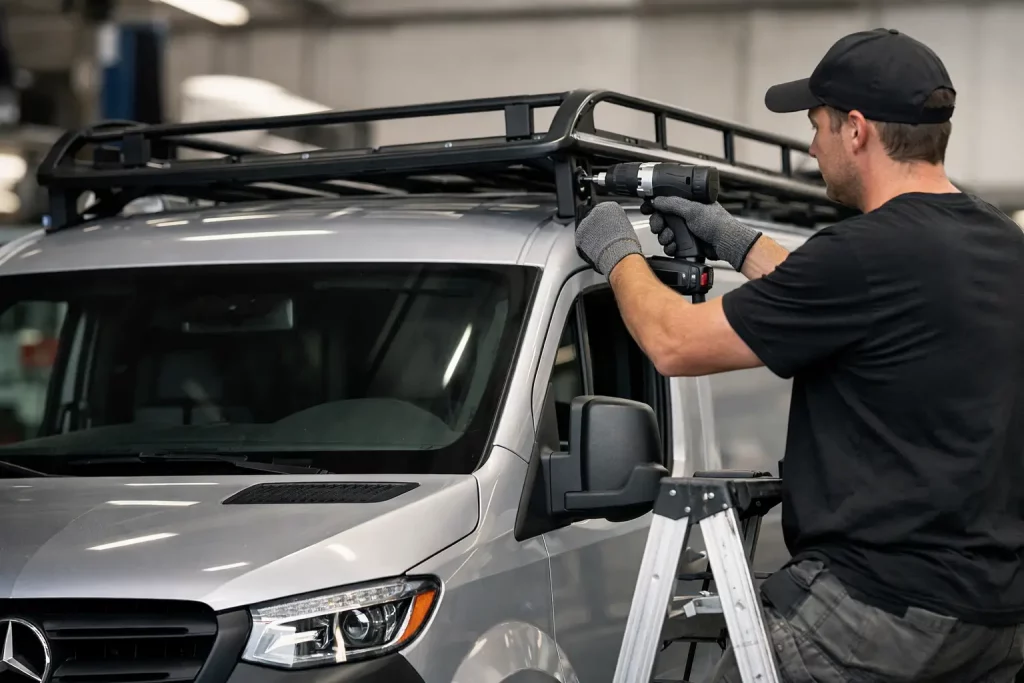
A Mercedes Sprinter rack repair example is rarely just about fitting another steering rack. On a working van, a complaint such as heavy steering, an intermittent warning lamp or a vague steering feel can originate in the rack itself, but it can also involve the electrical supply, wiring, steering-angle information, suspension geometry or a fault stored elsewhere in the vehicle. The right outcome begins with establishing what has actually failed before a replacement part is ordered.
The following representative case shows the process used when a right-hand-drive Mercedes Sprinter presents with an electrically assisted steering concern. Exact rack specification, diagnostic procedure and coding requirements vary by model year and VIN, but the principles are relevant to owners, fleet operators and workshops deciding whether reconditioning is suitable.
The reported fault: intermittent heavy steering
The vehicle was a later-model Sprinter used for local delivery work. The driver reported that the steering had become noticeably heavier at low speed, particularly during repeated parking manoeuvres. Assistance could return after switching the ignition off and on, but a steering-related warning message had appeared intermittently. There was no obvious impact damage, and the vehicle still tracked reasonably well on the road.
That description alone does not prove a failed electric power steering rack. Reduced assistance can be caused by low system voltage, poor earth connections, damaged wiring close to the rack, communication faults, an incorrectly calibrated steering-angle sensor or a mechanical restriction elsewhere in the steering and suspension system. A rack fault code is useful evidence, not a verdict.
For a commercial vehicle, this distinction matters. Replacing a complete assembly without resolving the underlying cause risks unnecessary expense and can leave the original symptom unchanged. Equally, continuing to operate a van with an intermittent steering-assistance fault is not a sensible fleet decision. The steering may feel manageable one moment and unexpectedly heavy the next.
Initial checks before rack removal
The inspection started with the basics that affect an EPS system. Battery condition and charging voltage were checked, followed by the relevant power supplies, earth points and connector condition. Modern steering systems are sensitive to voltage quality, especially on vans with additional electrical equipment, frequent short journeys or a battery approaching the end of its service life.
Diagnostic equipment was then used to read faults and live data from the appropriate control modules. The recorded fault history, whether a code was current or stored, steering-angle values, supply voltage and network communication all helped narrow the investigation. The workshop also checked for signs of water ingress, harness damage and mounting issues around the rack area.
Mechanical checks remain equally important. Track-rod ends, inner joints, lower steering column joints, tyres and front suspension components were examined for play or binding. A worn joint may not create an EPS fault code, but it can make steering feel imprecise and place extra load on the system. On a hard-working Sprinter, kerb strikes, potholes and overloaded use can all affect the front end.
In this case, the electrical supply and external wiring tested satisfactorily. The scan results and live data pointed towards an internal fault in the rack-mounted assistance system. The steering rack was removed for specialist assessment rather than immediately condemning the vehicle to a new complete unit.
Mercedes Sprinter rack repair example: component-level assessment
Once on the bench, the rack was identified by its exact part numbers and configuration. This is particularly important with Sprinter applications because apparently similar units may differ in software, connectors, motor arrangement, internal electronics and right-hand-drive compatibility. Matching by vehicle description alone is not enough.
The unit was inspected for impact damage, corrosion, water contamination and wear in the mechanical rack assembly. The pinion, rack bar, bearings, seals, inner joint areas and housing all need to be in serviceable condition before reconditioning is considered. If a rack is severely damaged, heavily corroded internally or has suffered a failure that compromises the casing or key components, complete replacement may be the more responsible route.
For a suitable unit, component-level reconditioning can address the defect without discarding a repairable assembly. The rack is stripped as required, worn or failed service components are replaced with appropriate OE or OE-quality parts where applicable, and the mechanical operation is restored to the correct standard. The electronic section is assessed according to the fault and the model-specific requirements.
This approach is different from simply cleaning and repainting a used rack. Reconditioning must deal with the cause of failure, verify the condition of the steering mechanism and confirm that the completed unit operates correctly under test. Cosmetic appearance has little value if the rack has not been properly assessed.
Testing, programming and the vehicle’s role
After repair, the rack was tested before leaving the workshop. Testing is a critical part of the process because it helps confirm smooth rack travel, correct mechanical operation and the performance of the relevant electrical elements. It also gives the fitting garage confidence that it is installing an assessed and tested steering component rather than an unknown used part.
Some applicable EPS racks may need flashing or virginising before installation so they can be coded to the vehicle. That is not a universal rule for every Sprinter, and it should never be assumed without checking the specific system. Depending on the model, vehicle-side coding, commissioning routines and steering-angle calibration may be required after fitting.
This is where communication between the steering specialist and the fitting workshop makes a real difference. The installer needs to know what state the repaired rack is supplied in, which procedures are expected after installation and whether dealer-level or suitably capable diagnostic equipment may be needed. The repair can be sound, but a vehicle that has not been correctly coded and calibrated may still display warning messages or have compromised assistance.
Refitting is not the final step
With the repaired rack installed, the steering column connection, rack fixings, track rods and associated components must be assembled to the manufacturer’s requirements. Any damaged wiring, poor connector seals or underlying electrical issue identified during diagnosis must also be corrected. Refitting a repaired rack into the same faulty electrical environment is an avoidable repeat failure risk.
A four-wheel alignment is then essential. Removing or replacing a steering rack alters the relationship between the rack, track rods and front wheels. Even if the steering wheel appears straight after assembly, toe settings can be outside specification. Incorrect geometry can cause poor straight-line stability, uneven tyre wear and a steering wheel that is off-centre.
On systems that require it, the steering-angle sensor is calibrated only after the geometry is correct. Calibration performed with an off-centre steering wheel or inaccurate alignment settings can create further issues. A final road test should confirm that steering assistance is consistent, the vehicle returns predictably from turns, there are no warning messages and the van tracks accurately.
When repair is the sensible option – and when it is not
A professionally reconditioned Sprinter rack can be a cost-effective option when the original unit is suitable for repair, the root cause has been identified and the correct installation procedures are followed. It can also reduce delays where a new unit has a long lead time, particularly for a fleet vehicle that needs to return to service promptly.
However, repair is not automatically the answer. Severe collision damage, extensive corrosion, unavailable electronic components, repeated water ingress or a vehicle-specific requirement for a replacement assembly can make a new or alternative unit more appropriate. The availability of parts and the condition of the original rack will always influence the decision.
For garages, the practical lesson is to diagnose the complete steering system before removing parts. For owners and fleet managers, it is worth asking whether the quoted solution is based on confirmed evidence, whether the rack will be tested, and what coding, calibration and alignment are included or required afterwards.
Pro Power Steering assesses suitable steering units at component level, provides technical support where needed and tests completed work before dispatch. Reconditioned work is supported by a 12-month warranty under the applicable terms. For a Sprinter that earns its keep every day, the objective is not simply to clear a fault code, but to return safe, smooth and precise steering with a repair path that fits the vehicle’s actual condition.
