
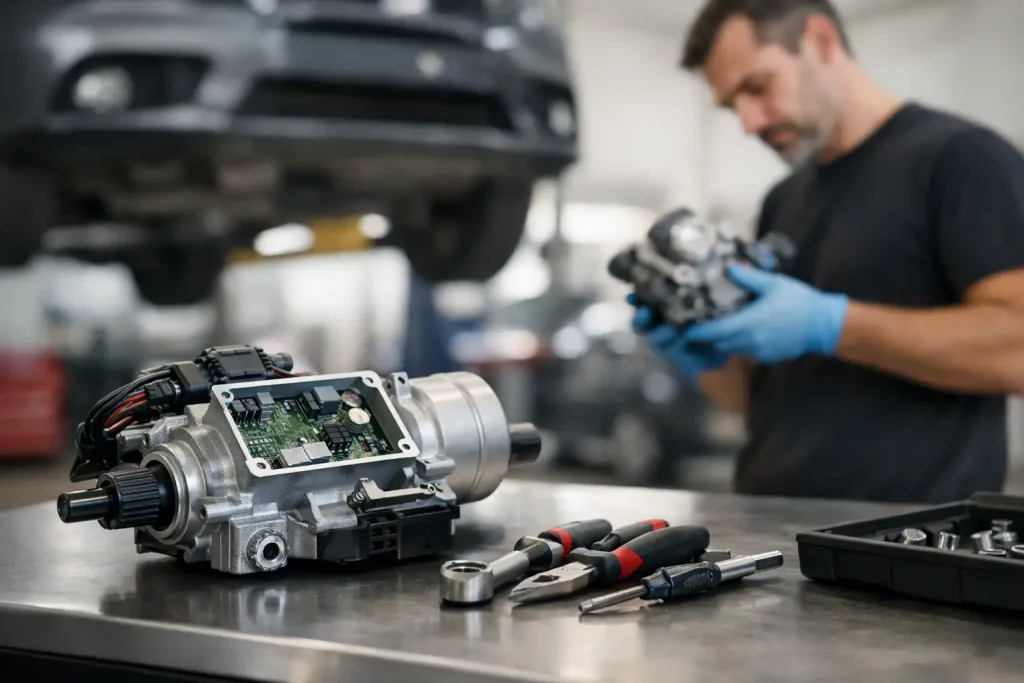
A warning light, heavy steering or intermittent loss of assistance can quickly lead to an expensive-looking diagnosis. An EPS module repair review should establish more than whether a fault code is present. It should identify whether the electronic power steering fault sits within the module itself, the rack, column, wiring, power supply or vehicle network – and whether a component-level repair is a sensible, safe option.
For vehicle owners and workshops, the difference matters. Replacing a complete electric steering rack or column may be necessary in some cases, but it is not automatically the only route. A proper assessment can prevent fitting the wrong part, repeating the fault or paying for replacement where a repairable electronic issue is the real cause.
What an EPS module repair review should assess
Electric power steering uses an ECU, motor, torque or position sensors and vehicle inputs to provide assistance appropriate to speed and steering demand. Depending on the vehicle, the EPS module may be incorporated into the rack, steering column or a separate control unit. That layout affects both diagnosis and repairability.
A useful review begins with the vehicle’s reported symptoms and a full diagnostic scan. Fault codes provide evidence, but they are not a complete diagnosis by themselves. A communication code, for example, could be caused by an internal ECU fault, damaged wiring, poor earth, low system voltage or another controller on the CAN network.
The assessment should also consider whether steering assistance changes with engine speed or road speed, whether the steering is consistently heavy or only fails intermittently, and whether there are warning messages after a battery fault, collision repair or previous component replacement. Physical checks are equally relevant. Water ingress, impact damage, corrosion at connectors and damage to the rack housing can alter the repair decision.
For trade customers, accurate vehicle identification is essential before a unit is removed or supplied. Part numbers, software versions and Right Hand Drive configuration can all be significant. Similar-looking racks or modules are not always electronically or mechanically interchangeable.
EPS module repair review: repair, recondition or replace?
The right option depends on the fault, the unit’s condition and the vehicle’s requirements after refitting. An internal electronic failure can sometimes be repaired at component level, particularly where the rest of the rack or column remains serviceable. This may involve identifying failed electronic components, restoring damaged connections and testing the completed unit under appropriate workshop conditions.
Reconditioning is broader than simply clearing fault codes or fitting a used module. On suitable units, it can include inspection of the steering assembly, attention to wear-related issues where applicable, replacement of appropriate OE or OE-quality components and functional testing before return. The aim is to return predictable assistance and precise steering operation, not merely to extinguish a dashboard warning.
Replacement remains the correct answer where a unit is beyond economical or safe repair. Severe impact damage, extensive corrosion, failed mechanical elements, unavailable electronic parts or a model with restricted software support may make replacement more appropriate. A new or manufacturer-exchange unit may also be preferable where a vehicle is still subject to a manufacturer warranty arrangement or where the required coding cannot be supported outside the dealer network.
A used unit can appear attractive on price, but it brings its own risks. Its history, internal condition, compatibility and coding status may be unknown. It may also carry the same age-related weakness as the original. A known, tested repair or reconditioned unit is often easier for a garage to stand behind, provided the underlying vehicle fault has been ruled out.
Coding, virginising and calibration are part of the job
An EPS repair is not always complete when the component is refitted. Many modern systems require vehicle-specific coding, initialisation or calibration before the warning light clears and assistance operates correctly. This can include steering angle sensor calibration, torque sensor zero-point setting, end-stop learning or configuration using manufacturer-level diagnostic equipment.
Where applicable, an EPS module or rack may be flashed or virginised to prepare it for coding to the recipient vehicle. This is especially relevant when an electronic module has been repaired or when a replacement unit is being installed. Virginising is not a universal solution, however. Some systems retain vehicle security information or require online access and manufacturer procedures that only a dealer or suitably equipped specialist can complete.
Wheel alignment should also not be treated as an afterthought. If a rack has been removed, disturbed following impact damage or fitted after a steering fault, the vehicle may require alignment and steering-angle recalibration. Incorrect alignment can leave the steering wheel off-centre, affect handling and, on certain vehicles, interfere with driver-assistance functions.
Symptoms that need careful diagnosis
EPS faults do not always present as total loss of assistance. The steering may become heavy only when parking, assistance may cut in and out after the vehicle warms up, or the steering may feel uneven from lock to lock. Some drivers notice a clicking sound, a notchy feel around centre or a warning message that disappears after restarting.
These symptoms should not be assumed to confirm a failed EPS module. A weak battery, charging-system issue, poor electrical connection or damaged harness can produce similar behaviour. So can mechanical resistance in the steering column, suspension joints or rack assembly. Diagnosing only from the dashboard warning risks replacing a costly part without curing the cause.
The same principle applies after accident repairs. A steering rack that has suffered a kerb strike or collision may have mechanical damage even if the principal stored code refers to the electronics. Conversely, a system may report an internal module error when moisture has travelled through a connector or damaged the wiring nearby. The most reliable repair path considers electrical, electronic and mechanical evidence together.
What a specialist repair process adds
A steering specialist is focused on the complete system rather than one diagnostic screen or a catalogue replacement. That matters on premium, performance, classic and commercial vehicles, where parts availability, calibration requirements and vehicle-specific variations can be substantial.
At Pro Power Steering, suitable EPS units are assessed for repairability before reconditioning work is agreed. Component-level work is paired with workshop testing, and direct technical advice can be provided to the fitting garage where coding, calibration or installation questions arise. Completed repairs are supported by a 12-month warranty under the applicable terms.
For customers outside the workshop area, UK-wide collection and delivery can make specialist assessment practical for suitable steering components. It remains important to confirm what is being sent, its part number, the vehicle details and the original fault information. Good information at the start helps avoid delays and supports a more accurate diagnosis.
Questions to ask before authorising EPS work
Before deciding between repair and replacement, ask whether the fault has been confirmed beyond the code description, whether the rack or column has been checked for mechanical damage, and whether the vehicle will need coding or calibration after refitting. A garage should also establish whether alignment is required and whether the selected repair carries clear warranty terms.
It is worth asking what has actually been tested. A unit that powers up on a bench is not necessarily proven under the loads and signals it sees in a vehicle. Equally, an internal module repair may be technically sound but still fail to resolve the complaint if a charging, wiring or network fault remains in the car.
The best EPS repair decision is therefore not the cheapest component on paper or the quickest route to clearing a warning. It is the route supported by proper diagnosis, compatible parts, correct coding and a final check that the steering is smooth, centred and dependable on the road.
