
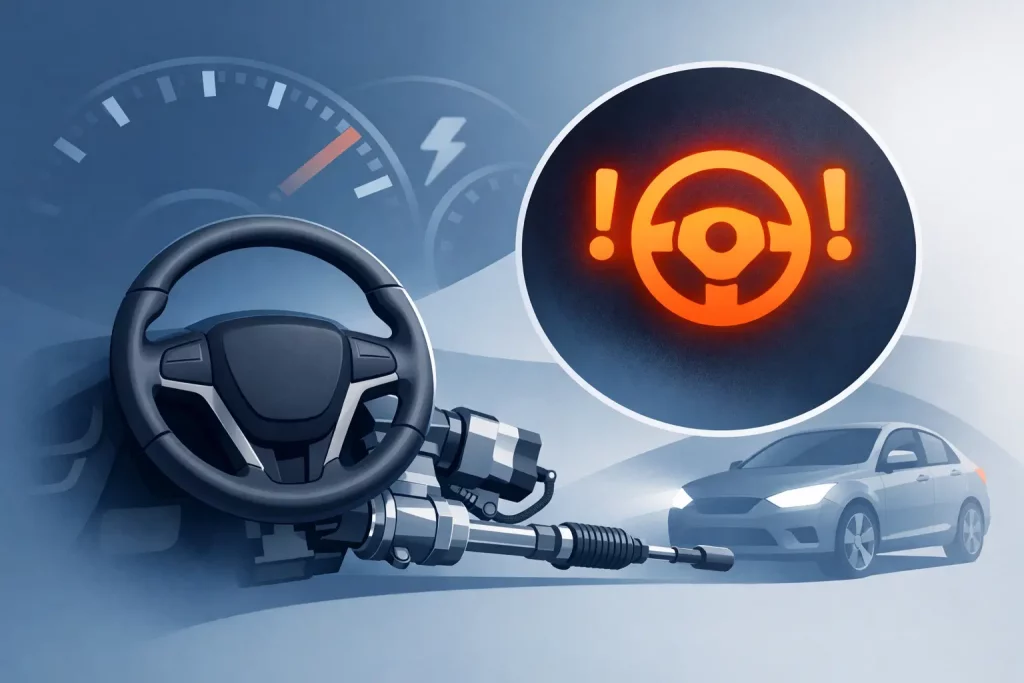
A steering wheel that becomes unexpectedly heavy while manoeuvring is more than an inconvenience, particularly in traffic or a tight car park. When the electric power steering warning light appears, the vehicle has detected a fault that may reduce or disable steering assistance. The car can usually still be steered, but it may require considerably more effort, so the warning should never be ignored.
Electric power steering, commonly called EPS, uses an electric motor and electronic control system to provide assistance only when it is needed. It is efficient and responsive, but it relies on sound electrical supply, accurate sensor information and correctly functioning mechanical steering components. A proper diagnosis identifies which of these areas has caused the warning, rather than assuming the complete steering unit needs replacing.
What the Electric Power Steering Warning Light Means
The symbol varies by manufacturer, but it commonly shows a steering wheel with an exclamation mark. An amber or yellow light usually indicates that a fault has been stored and assistance may be limited. A red warning, or a warning accompanied by very heavy steering, should be treated as more urgent.
On some vehicles, the light may illuminate briefly at ignition and then go out as part of the normal system check. It becomes a concern when it remains on after starting, appears during driving, or returns repeatedly after the ignition has been switched off and on.
EPS systems are fitted to a wide range of modern cars, vans and performance vehicles. Depending on the design, the motor and control electronics may be mounted on the steering column, integrated into the rack, or connected through a separate control module. The precise fault path therefore differs between vehicles. A generic code reader can be useful, but it does not always access manufacturer-specific steering codes or provide enough information to justify replacing parts.
Is It Safe to Drive With an EPS Warning?
It depends on how the vehicle is behaving. If steering assistance is still present and the wheel feels normal, the car may be moved carefully to a safe location or booked in for diagnostics. However, a warning light means the system is operating outside its intended condition, and the fault can worsen without notice.
If the steering becomes notably heavy, inconsistent, notchy or reluctant to self-centre, avoid routine driving. The effort required at low speeds can be substantial, making parking, roundabouts and emergency manoeuvres more difficult. Do not continue driving if the warning is red, if several electrical warnings appear together, or if the steering response feels unpredictable.
A warning that disappears after restarting is not proof that the problem has fixed itself. Intermittent faults are common with low supply voltage, deteriorating connections, sensor signal issues and internal electronic failures. Stored fault codes and live data are often needed to establish what happened at the moment assistance was lost.
Common Causes of an EPS Warning Light
Low battery voltage or charging faults
EPS draws a significant amount of electrical current, especially during low-speed steering. A weak battery, poor battery connection or charging-system issue can cause the steering control module to register undervoltage and withdraw assistance as a protective measure.
This is particularly common after a flat battery, jump starting, long periods off the road or repeated short journeys. The vehicle may also display stop-start, ABS, stability-control or battery-related warnings. Testing battery condition, terminal security and charging voltage is a sensible first step, but it should not replace a full steering-system scan if the warning returns.
Faulty torque, angle or position sensors
The EPS control unit must know how much steering input the driver is applying and where the wheels are positioned. Torque sensors, steering-angle sensors and motor-position sensors provide this information. If their readings are implausible, missing or outside tolerance, the system may limit assistance or shut it down.
Sensor-related faults can cause uneven assistance, a steering wheel that feels heavier in one direction, poor self-centring or a warning that appears after turning the wheel. In some cases, calibration or coding is required after repair. Replacing a component without completing the required set-up can leave the warning active and the steering performance incorrect.
Wiring, connectors and earth connections
Electrical faults are not always inside the steering rack or column. Moisture ingress, corroded terminals, damaged wiring and weak earth connections can interrupt communication or power supply to the EPS system. These faults can be intermittent, which makes them easy to misdiagnose.
A specialist inspection checks the condition of relevant connectors and wiring, together with voltage drop under load. Simply clearing the code may extinguish the light temporarily, but it will not repair a high-resistance connection or damaged harness.
Internal EPS motor, module or rack faults
The motor, control module and mechanical rack assembly work together. Internal wear, electronic component failure, contamination or overheating can produce fault codes that point to the EPS unit itself. On rack-mounted systems, a fault may affect both electronic assistance and the accuracy of steering movement.
Main dealers often quote for a complete new assembly. That can be the correct route in some cases, particularly where parts are unavailable or the unit has suffered extensive damage. However, component-level diagnostics and reconditioning can often provide a cost-effective alternative where the steering unit is suitable for repair. The right decision depends on the fault findings, the vehicle application and the condition of the existing unit.
Mechanical steering resistance
EPS cannot compensate indefinitely for a binding or worn mechanical component. Seized joints, damaged rack internals, incorrect alignment or impact damage can increase steering load and cause the system to work harder than intended. The result may be heavy steering, fault codes related to excessive motor effort, or a warning that occurs mainly when manoeuvring.
This is why diagnosis should include a physical assessment of the steering and suspension system, not only an electronic scan. A replacement EPS module will not cure a steering rack that is mechanically tight or a vehicle with poor wheel alignment.
What a Proper EPS Diagnosis Should Include
Accurate diagnosis saves money because it separates the cause of the fault from the symptom. The warning light itself does not identify a failed rack, column or motor. It only confirms that the steering control system has found a problem.
A specialist process normally begins with confirmation of the customer’s symptoms: when the light appears, whether assistance is lost completely, and whether the issue follows low voltage, wet weather, turning at full lock or a recent repair. The vehicle is then scanned using suitable diagnostic equipment to read steering-specific codes, module communication status and live sensor values.
Electrical supply and earth integrity should be tested under operating conditions. The technician can then assess steering torque signals, angle information, motor demand and control-module response. A road test may be appropriate where the vehicle remains safe to operate. Finally, the rack, column, joints and alignment are inspected for mechanical resistance or damage.
The outcome should be clear: repair the wiring or power-supply issue, recalibrate a sensor, repair or recondition the EPS component, or fit a replacement unit where repair is not viable. On certain vehicles, coding, initialisation and steering-angle calibration are essential after installation. Skipping these steps can create further warning lights and compromise driving assistance.
Avoid These Common Responses
Do not keep resetting the warning light and hope it stays away. Clearing codes removes diagnostic evidence and may delay a repair until the steering becomes much heavier. Likewise, avoid fitting used electronic steering components without checking compatibility, part numbers and programming requirements. A second-hand unit may carry the same internal weakness, may not communicate correctly with the vehicle, or may require coding that has not been completed.
Battery replacement can resolve an undervoltage event, but it should not be used as an automatic answer to every EPS warning. If the light persists after the electrical system has been verified, more detailed steering diagnostics are needed.
Repair, Reconditioning or Replacement?
There is no single answer for every EPS fault. A newer vehicle with a confirmed internal module failure may need a replacement assembly if the manufacturer design prevents practical repair. Conversely, a repairable steering rack or column unit can often be reconditioned, tested and refitted for less than the cost of a new dealer-supplied component.
For older, specialist and RHD vehicles, correct application matters as much as the repair itself. Steering systems can differ across model years, engine variants and left- or right-hand-drive configurations. A vehicle-specific approach prevents fitting errors and protects the steering geometry and intended handling characteristics.
Pro Power Steering carries out specialist EPS diagnostics, repair and reconditioning work for vehicles where accurate fault finding is the priority. Completed work is supported by a 12-month guarantee, giving owners and workshops a clear repair route beyond automatic whole-unit replacement.
When to Arrange Specialist Attention
Arrange an inspection promptly if the warning remains illuminated, returns intermittently, or is accompanied by heavy steering, uneven assistance, pulling, noise or poor self-centring. If assistance has failed completely, do not treat the vehicle as normal transport simply because the wheel can still be turned.
The most useful information to provide is the vehicle registration or full model details, the exact warning displayed, when it occurs and whether any recent battery, suspension or steering work has been carried out. Those details help direct diagnosis from the outset and give the best chance of restoring smooth, precise steering without unnecessary parts replacement.
