
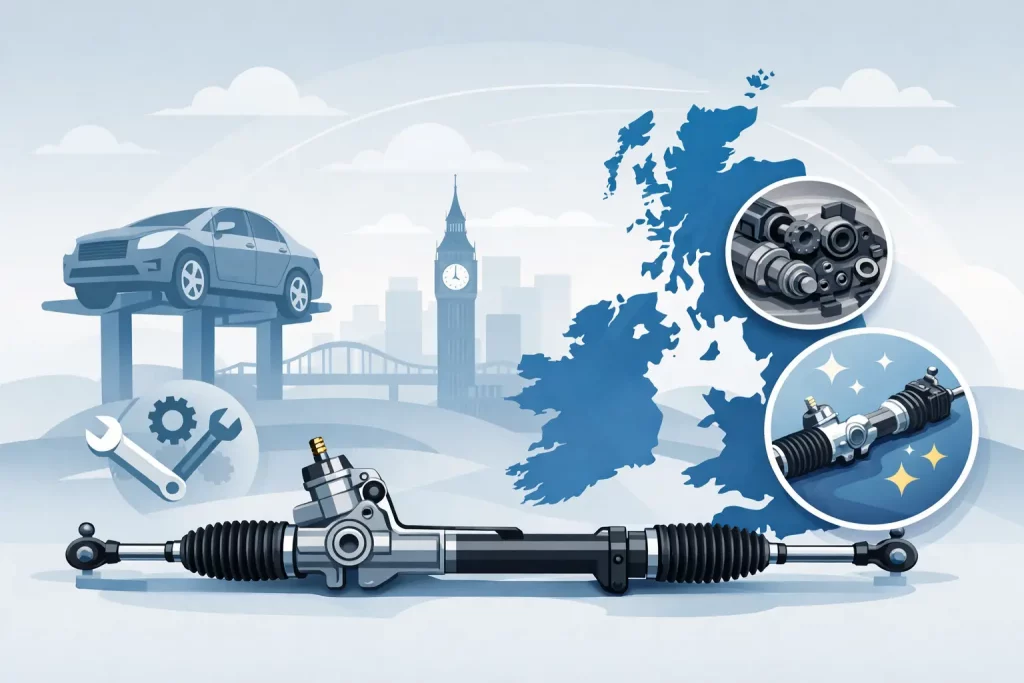
A steering rack fault rarely arrives without warning. The steering may feel unusually heavy during parking, fail to self-centre properly after a turn, wander on the motorway, or develop a knock that is felt through the wheel. For many owners, the first quotation is for a costly new assembly. Reconditioned steering racks UK motorists can source through a steering specialist offer a more considered alternative – provided the original fault is diagnosed correctly and the unit is rebuilt to the right standard.
A properly reconditioned rack is not simply a cleaned second-hand part. It is an original unit that has been stripped, inspected, renewed where necessary, reassembled to specification and tested before it is returned to service. That distinction matters to private owners, workshops and fleet operators alike, because steering is central to both vehicle safety and driving accuracy.
What a reconditioned steering rack actually involves
The steering rack converts the movement of the steering wheel into the controlled movement that turns the road wheels. Depending on the vehicle, the system may be hydraulic, manual or integrated with electric power steering assistance. The rack itself contains precision components that must work together without excess play, fluid loss or tight spots.
During proper reconditioning, the unit is dismantled so that wear can be assessed rather than guessed at. The rack bar, pinion, housing, internal seals, bearings, bushes and adjustment components are inspected for damage, corrosion and dimensional wear. Serviceable parts are retained only where they meet the required standard; worn or failed items are replaced. The assembly is then rebuilt, adjusted and tested for smooth operation, correct assistance where applicable, and the absence of leaks or excessive free play.
This is why the term “reconditioned” should not be treated as interchangeable with “used”. A used rack may have been removed from another vehicle with no meaningful knowledge of its mileage, storage conditions or internal condition. It may be cheaper at the point of purchase, but it can transfer the same failure risk to the next vehicle. A reconditioned unit should have a defined inspection and rebuild process behind it.
When reconditioning is the sensible option
Reconditioning is often particularly worthwhile when a new genuine rack is disproportionately expensive, unavailable, or no longer supplied for an older vehicle. It can be a strong choice for premium cars, classics, sports cars, commercial vehicles and vehicles where the original steering geometry and component specification are worth preserving.
It is also practical where the fault is confined to serviceable internal wear, failed seals, damaged mounting points or worn mechanical components. A specialist can assess whether the rack housing and core components are suitable for rebuilding. If they are, a reconditioned rack can restore controlled, predictable steering at a lower cost than dealer-led replacement.
There are limits. Severe impact damage, badly corroded casings, cracked housings or extensive electronic failure can make reconditioning uneconomical or unsuitable. Some modern electric systems also require vehicle-specific coding, calibration or diagnostic work after installation. The right answer depends on the rack fitted to the vehicle, the nature of the fault and the condition of the surrounding steering and suspension components.
Diagnosis should come before parts supply
Heavy or inaccurate steering does not automatically mean the rack has failed. Worn track rod ends, inner joints, suspension bushes, a steering column issue, low system pressure in applicable systems, tyre condition or poor wheel alignment can all create similar symptoms. On electric power steering vehicles, warning lights and intermittent loss of assistance can also point to sensor, wiring, control-unit or motor-related faults rather than a mechanical rack problem.
Replacing a rack without confirming the cause can be an expensive mistake. A proper steering diagnostic process should include a road assessment where safe to do so, inspection for movement and leaks, checks of the steering linkage and suspension, and fault-code analysis on electronically controlled systems. The aim is to identify the failed component and any contributing issue before parts are ordered or removed.
For garages, this is especially important when a vehicle has already had one unsuccessful repair. A customer may report that the replacement rack has made no difference, only for the real cause to be elsewhere in the system. Specialist diagnosis prevents unnecessary labour, repeat bookings and avoidable warranty disputes.
Choosing between new, used and reconditioned racks
A new genuine rack may be the correct route where manufacturer supply is readily available, the vehicle is still under a relevant warranty arrangement, or a specialist determines that the original unit cannot safely be rebuilt. New parts provide a clear baseline, although their cost can be difficult to justify on an older vehicle.
Used parts can appear attractive, particularly for low-value cars. However, their history is normally unknown and there is no guarantee that internal wear will not become apparent shortly after fitting. The labour involved in replacing a steering rack means a low purchase price can become poor value if the unit must be removed again.
A quality reconditioned unit sits between these options. It retains the correct original design while renewing the components most affected by age and use. The value is not merely in the part itself; it is in the technical process, testing, traceability and warranty support that should accompany it. For many vehicles, that balance makes reconditioning the most sensible repair route.
Why vehicle-specific expertise matters
Steering racks are not generic components. Mounting arrangements, rack travel, pinion configuration, electrical connections, sensor systems and calibration requirements vary widely between makes and models. Even two visually similar racks may not be interchangeable.
This is particularly relevant on Audi, BMW, Mercedes, Jaguar, Land Rover and Porsche vehicles, where steering systems can be closely linked to electronic control functions and driver-assistance features. Supplying the wrong variant can lead to installation difficulties, warning messages or steering behaviour that is not correct for the vehicle.
A specialist will identify the rack accurately using the vehicle registration, VIN where required, original part number and physical specification. This protects against a common problem in parts supply: ordering by model name alone and receiving a unit that is almost, but not quite, correct.
Installation work is part of the repair
A rebuilt rack can only perform as intended if it is fitted correctly. The vehicle must be supported safely, the steering wheel and road wheels positioned correctly, and all relevant fixings tightened to the manufacturer’s specification. Any contaminated fluid or debris in a hydraulic system must be dealt with before a replacement unit is put into use, otherwise the same contamination can damage the rebuilt component.
Once installed, the steering system should be checked through its full range of movement. The vehicle then needs wheel alignment, because rack removal and refitting affects toe settings. An alignment check is not an optional finishing touch. Incorrect geometry can cause a crooked steering wheel, poor straight-line stability, tyre wear and a misleading impression that the steering rack is at fault.
On vehicles with electronic steering functions, calibration or reset procedures may also be required. These can include steering-angle sensor calibration and clearing or investigating fault codes. A workshop that treats the job as a straightforward mechanical swap may miss these essential final steps.
Questions worth asking before you buy
Before authorising work or ordering a unit, ask whether the rack has been diagnosed as the confirmed cause of the problem, what components are renewed during reconditioning, and how the completed unit is tested. It is also sensible to ask about the warranty period, whether the warranty covers the part or completed repair, and what fitting conditions apply.
For trade customers, core-return arrangements and turnaround times matter as much as the unit price. A repairable exchange core can make the process more economical, but it must be the correct type and in a condition suitable for assessment. Clear communication on part numbers, symptoms and vehicle specification avoids delays.
Pro Power Steering approaches this work as a steering-system repair rather than a parts transaction. That means matching the right reconditioned unit to the vehicle, carrying out targeted diagnostics and ensuring the steering is returned to smooth, accurate operation with appropriate warranty protection.
If your vehicle has developed heavy, noisy, loose or inconsistent steering, avoid assuming that a replacement rack is automatically required. Have the system assessed by a specialist first. The best repair is the one that identifies the real fault, restores confidence at the wheel and gives the vehicle a dependable steering response for the miles ahead.
