
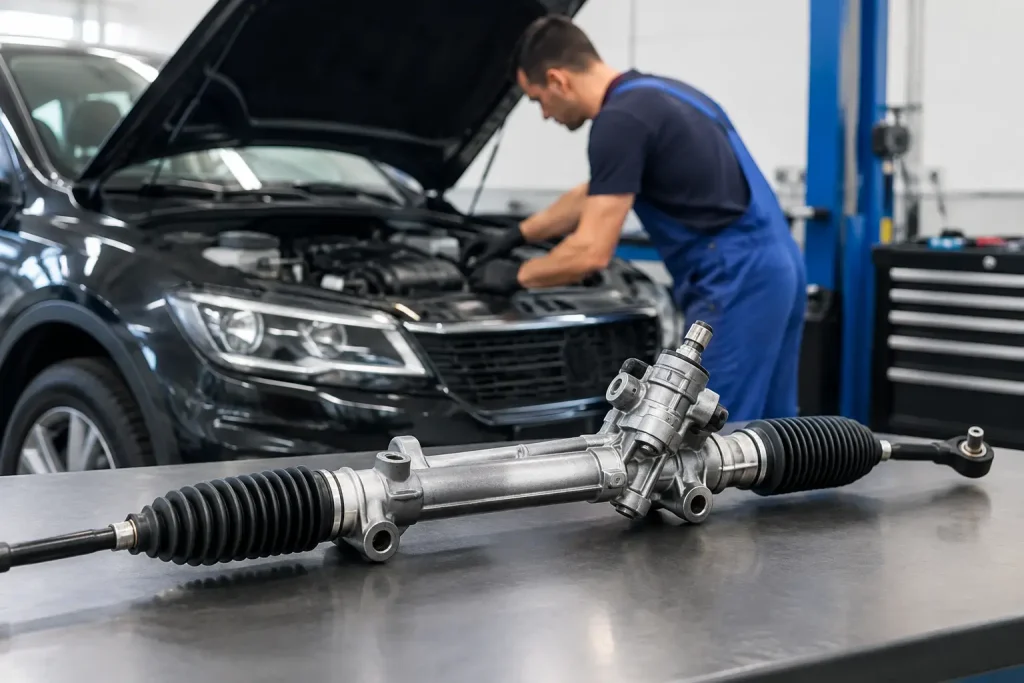
A replacement or reconditioned electric power steering rack can be mechanically correct yet still leave warning lights, heavy assistance or fault codes if the vehicle has not accepted it electronically. The question, “EPS coding needed?”, therefore has no one-size-fits-all answer. It depends on the vehicle manufacturer, the steering system fitted, the work carried out and whether the original control unit remains with the car.
Modern EPS systems are part of the vehicle’s wider electronic architecture. They exchange information with stability control, steering-angle sensing, driver-assistance systems and, on some models, suspension or drive-mode controls. Repairing the steering hardware is only part of returning the system to proper operation.
When is EPS coding needed?
EPS coding is commonly needed when an electric steering rack, column or its integrated control module has been replaced. The vehicle may need to identify the unit, write its configuration data, match it to the vehicle specification or remove transport and component-protection states. On certain applications, a new or donor unit will not provide assistance correctly until this process has been completed with suitable diagnostic equipment.
The exact requirement varies considerably. Some racks retain their original electronic control unit and may only require fault-code clearing, steering-angle calibration or end-stop learning after refitting. Others contain a module that is coded specifically to the vehicle, sometimes with security-related procedures that require manufacturer-level access. A rack taken from a similar vehicle is not automatically compatible simply because the connectors and mounting points match.
This is particularly relevant on premium vehicles, where steering assistance can be affected by wheel size, engine variant, suspension specification, driving modes and driver-assistance equipment. Right Hand Drive applications also need careful identification. A physically similar Left Hand Drive rack is not an equivalent substitute, and software or configuration differences can add another layer of complication.
Coding, calibration and alignment are different jobs
These terms are often used interchangeably, but they address separate parts of the repair.
Coding writes or confirms vehicle-specific configuration in an electronic control unit. Depending on the system, this may include the vehicle identification number, equipment specification, steering variant or control-module programming. Coding is concerned with whether the vehicle recognises and can communicate correctly with the fitted unit.
Programming or flashing updates the module software. It may be required where the manufacturer specifies a later software level, where a replacement module is supplied blank, or where a suitable reconditioned EPS rack has been prepared for installation. A rack may be flashed or virginised in preparation for vehicle-specific coding, but that does not remove the need for the receiving vehicle to be configured and calibrated correctly.
Calibration teaches the vehicle reference positions and sensor values. This can include steering-angle sensor zeroing, torque-sensor learning, rack-centre or end-stop learning, and calibration of driver-assistance functions. It is essential that the steering wheel, front wheels and rack are correctly centred before relevant procedures are run. Calibrating an incorrectly centred system can create further problems rather than solve them.
Wheel alignment is a mechanical measurement and adjustment process. After rack removal, inner joint work, subframe movement or impact damage, alignment should be checked and adjusted as necessary. An electronic calibration cannot correct incorrect toe settings, a bent component or a steering wheel that is off-centre because the geometry is wrong.
Signs that an EPS installation has not been completed
A vehicle may start and steer after a rack has been fitted, but that alone does not prove the work is complete. Common signs that coding, calibration or further diagnosis is required include an EPS warning lamp, reduced or intermittent assistance, stored communication faults, a steering wheel that does not sit straight, or stability-control and driver-assistance warnings.
Some faults only become apparent on the road. Assistance may feel inconsistent between left and right lock, unusually heavy during parking, or different once the vehicle is moving. On variable-assistance systems, the steering may feel acceptable in one drive mode but wrong in another. These symptoms should not be dismissed as a normal characteristic of a replacement rack.
Equally, not every warning following steering work is caused by coding. Low battery voltage, damaged wiring, poor earth connections, an incorrect rack part number, sensor faults elsewhere in the vehicle or geometry issues can all produce similar complaints. Accurate steering diagnostics should establish what the control modules are reporting before a unit is condemned or programmed unnecessarily.
Why component preparation matters before fitting
The most cost-effective repair is not always a direct replacement with a complete new assembly. Where suitable, a steering rack can be assessed and reconditioned at component level, using appropriate OE or OE-quality parts. The unit should then be tested before it leaves the workshop. This approach can preserve an otherwise serviceable assembly while addressing the actual mechanical or electrical fault.
However, repairability depends on condition and design. Severe accident damage, unsuitable electronic faults, unavailable components or internal corrosion may make reconditioning impractical. In those cases, replacement may be the sounder option. The fitting garage also needs to know whether the unit is supplied with its original module, a replacement module or a prepared module requiring vehicle coding.
For applicable EPS models, preparing a rack through flashing or virginising can make installation more straightforward for a workshop with the right diagnostic capability. It is not a shortcut around manufacturer procedures. The vehicle still needs the correct coding and post-installation checks, and some systems may require dealer involvement or authorised diagnostic access.
A sensible process after EPS rack work
Before parts are ordered, confirm the vehicle identification details, original rack number, steering-system variant and fault information. This reduces the risk of fitting a unit that is mechanically similar but electronically unsuitable. If the original rack is still fitted, a full scan and a record of current faults can be valuable evidence when deciding whether the fault lies in the rack, column, wiring, battery supply or another module.
After installation, the workshop should inspect connectors, routing and mounting points, establish that the rack is centred, and verify that the steering column and road wheels are aligned correctly. Diagnostic procedures should then be performed in the order specified for that vehicle. This may include coding, software programming, clearing fault memory, steering-angle calibration and end-stop learning.
A road test and final diagnostic scan are equally useful. The steering should return smoothly, assistance should be consistent, and no related warning lights or faults should remain. If wheel alignment has been disturbed, it should be measured using suitable equipment rather than judged by the position of the steering wheel alone.
Choosing the right support for the job
Owners often focus on whether a rack can be supplied, while independent garages need confidence about what happens after it arrives. The practical question is whether the workshop has the information, equipment and access needed to complete the electronic side of the repair. If not, arranging coding and calibration in advance prevents the vehicle being left immobile or returned with warning lamps.
Pro Power Steering supports suitable EPS repairs with specialist diagnosis, component-level reconditioning, tested steering units and direct technical advice for fitting garages. Where applicable, racks can be prepared for vehicle-specific coding and calibration. Completed work is supported by a 12-month warranty under the applicable terms, but correct installation and required vehicle procedures remain essential to reliable operation.
If a car has had steering work and does not feel precise, light and predictable afterwards, treat that as a diagnostic question rather than an inconvenience to live with. The correct final step may be coding, calibration, alignment or a closer look at the fault data – and identifying which one is what protects both the repair and the way the vehicle drives.
