
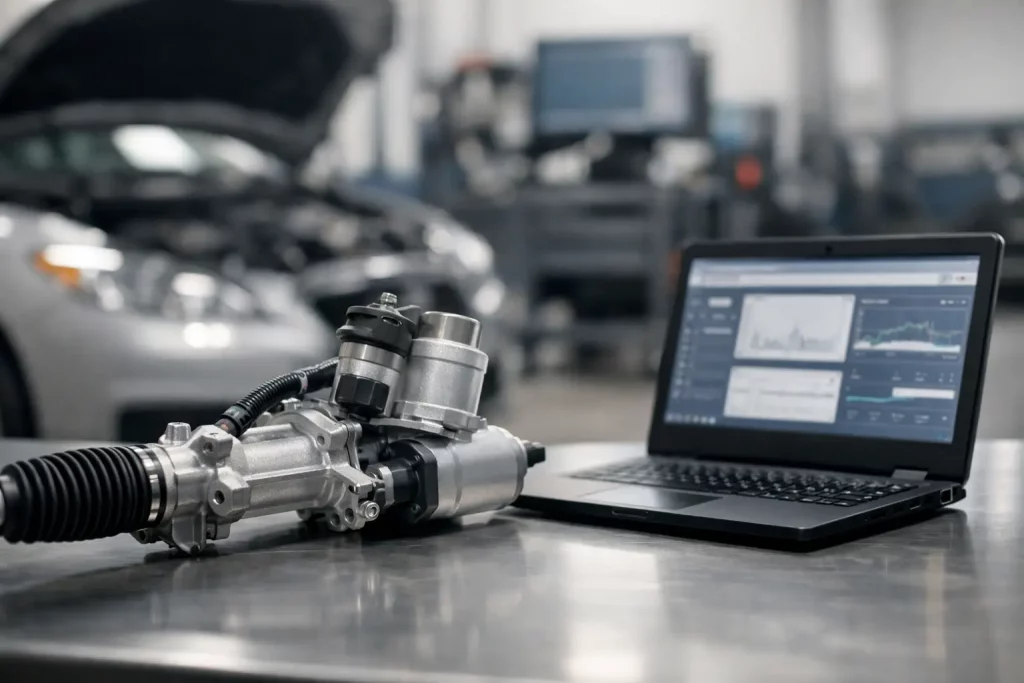
A modern steering rack is not simply a mechanical part fitted beneath the car. On many vehicles, the electric power steering system is a networked control unit that must recognise the vehicle it has been fitted to. EPS coding is the process that allows the steering electronics to communicate correctly with the rest of that vehicle.
This matters when an EPS rack, column or control unit has been replaced, reconditioned or transferred from another vehicle. Without the correct preparation, coding and calibration, the vehicle may retain warning lights, lose assistance, log communication faults or deliver steering that does not feel as it should. The right route depends on the make, model, year, steering design and the fault that led to the repair.
What EPS coding actually means
Electric power steering, usually referred to as EPS, uses an electric motor and electronic control module to provide steering assistance. Depending on the vehicle, the motor may be fitted to the steering column, pinion or rack. The module receives information from sensors and other vehicle systems, then adjusts assistance according to steering input, vehicle speed and operating conditions.
EPS coding is a broad term. In practice, it can include writing vehicle-specific data to the steering module, programming a replacement control unit, matching component configuration, clearing transport or commissioning modes, and teaching the module relevant end stops or sensor reference positions.
The exact procedure is manufacturer-specific. A system fitted to a BMW, Audi, Mercedes-Benz, Jaguar, Land Rover or Porsche may require a different diagnostic process, security access level or software environment from another vehicle. Even two similar-looking racks can have different hardware, software or vehicle configuration requirements.
Coding should not be confused with fault-code reading. Diagnostic trouble codes identify reported faults or communication problems. Coding configures the unit for the vehicle. Clearing a warning code does not necessarily make a replacement rack acceptable to the car, and fitting a physically compatible unit does not guarantee it can be coded successfully.
When a steering system may need coding
Coding is commonly considered after replacement of an electric steering rack or steering column. It may also be required where the EPS control module has been replaced, where a unit has lost its stored configuration, or after a rack has been correctly rebuilt and prepared for refitting.
However, not every electric steering repair requires coding. Some faults are caused by worn internal rack components, damaged wiring, poor power or earth connections, a weak battery, corrosion in connectors or an unrelated issue elsewhere on the vehicle network. Correct diagnosis before removal prevents a repair from being mistaken for a programming problem.
A replacement unit can introduce another variable. Used parts may still be paired to their donor vehicle, configured for different equipment or contain software that is unsuitable for the recipient car. Certain systems also carry security or immobiliser-related restrictions that cannot be overcome by ordinary diagnostic equipment. In those cases, dealer-level programming, an approved specialist procedure or a new component may be necessary.
For this reason, a steering specialist should assess the part number, vehicle identification, stored faults and live data before advising on repair, reconditioning or replacement. The most cost-effective answer is not always the cheapest available rack. It is the option that can be fitted, configured and verified correctly.
Flashing and virginising an EPS rack
Two terms often arise when an EPS rack is being prepared for installation: flashing and virginising. They are related but not interchangeable.
Flashing generally means loading or updating software or data within the electronic control unit. This may be needed where the original software is corrupt, where a module has to be prepared for a particular application, or when the manufacturer procedure calls for an update after installation. Successful flashing depends on having the correct hardware and software reference for the vehicle.
Virginising means removing or resetting certain stored vehicle-specific information so that a module can be commissioned to another appropriate vehicle. On applicable EPS systems, this can make a reconditioned rack ready for the vehicle-specific coding stage. It is not a universal service and is not suitable for every control unit. Some modules are locked by design, while others must be programmed through manufacturer systems.
The distinction is useful for workshops and owners arranging a supply-only rack. A unit described as reconditioned may be mechanically sound, but the electronic preparation still needs to match the vehicle and the planned fitting process. Clarifying this before ordering helps avoid a car occupying a ramp while a coding issue is discovered afterwards.
Coding is only one part of a correct repair
A steering rack can communicate with the vehicle and still require further work before it is ready for the road. Calibration establishes reference values used by the steering system, particularly for the steering angle sensor and, on some vehicles, the rack position or torque sensor. If these values are incorrect, the EPS module and safety systems may receive misleading information.
Wheel alignment is equally relevant. Removing and refitting a rack, disturbing track rods or replacing steering components can alter toe settings. A vehicle may drive straight enough to leave the workshop yet still suffer tyre wear, an off-centre steering wheel or unstable handling. Alignment should be checked and adjusted to the manufacturer’s specification after the mechanical work is complete.
The usual order matters. First, ensure the correct rack is fitted properly and all connections are secure. Then perform required coding or programming, complete calibrations using suitable diagnostic equipment, and carry out wheel alignment where necessary. Finally, confirm the steering warning lamp status, check for returning faults and road-test the vehicle where appropriate.
There are exceptions. Some manufacturer procedures specify a different sequence, particularly where an initialisation routine requires the wheels to be straight ahead. Following the vehicle-specific process is more reliable than applying a generic routine across every make.
Signs of an EPS fault are not always signs of a failed rack
Heavy steering, intermittent assistance, a red or amber steering warning light, inconsistent self-centring and messages relating to steering assistance all warrant investigation. Yet these symptoms do not automatically mean the rack itself has failed.
EPS systems rely on stable voltage and clean network communication. A low battery, charging-system fault, damaged loom, water ingress, connector issue or fault in another control unit can affect steering operation. Likewise, mechanical causes such as seized suspension joints, incorrect geometry or tyre-related problems can make a driver feel that the steering is heavy even when the EPS motor is functioning normally.
Accurate diagnostics should therefore include a scan of relevant vehicle systems, inspection of power supplies and connections, assessment of mechanical steering operation and consideration of the vehicle’s history. If a rack has already been changed and coding will not complete, checking compatibility and electrical fundamentals is often more productive than repeatedly attempting the same programming routine.
Choosing the right EPS repair route
There are three broad outcomes after diagnosis. A fault may be resolved by repairing an external issue, such as wiring or a connection. A suitable rack may be reconditioned at component level, retaining the original vehicle-matched unit where practical. Or replacement may be required because the internal damage, electronics or parts availability make repair unsuitable.
Reconditioning can be a sensible option where a specialist can identify the underlying internal defect and rebuild the unit using appropriate OE or OE-quality parts. It also retains the value of an original component that may be easier to configure than an unknown used unit. But it is not appropriate for every rack, and the condition of the electronics must be assessed separately from the mechanical assembly.
For applicable EPS models, Pro Power Steering can assess units for repair and reconditioning, with flashing or virginising preparation where suitable. Rebuilt units are tested before leaving the workshop, and direct technical support can help fitting garages understand the coding and calibration requirements. Completed work is supported by a 12-month warranty under the applicable terms.
Information to provide before booking work
A clear fault description gives the diagnostic process a stronger starting point. Include the registration number or VIN, make and model, year, engine and transmission where relevant, the rack or steering module part number, dashboard messages and all stored diagnostic codes. It is also useful to state whether the original rack remains fitted, whether a replacement has already been installed, and whether the fault followed battery work, accident damage or water ingress.
For trade customers, this information helps establish whether a unit can be supplied prepared for coding, whether the original needs to be sent for assessment, and whether programming must be completed on the vehicle after fitting. It reduces uncertainty and helps plan ramp time realistically.
EPS coding is most effective when it is treated as part of a complete steering repair rather than a final button press. Match the correct component to the vehicle, diagnose the cause properly, programme only where required, calibrate the system and verify the alignment. That process is what returns the steering to the smooth, precise and predictable operation the vehicle was designed to deliver.
