
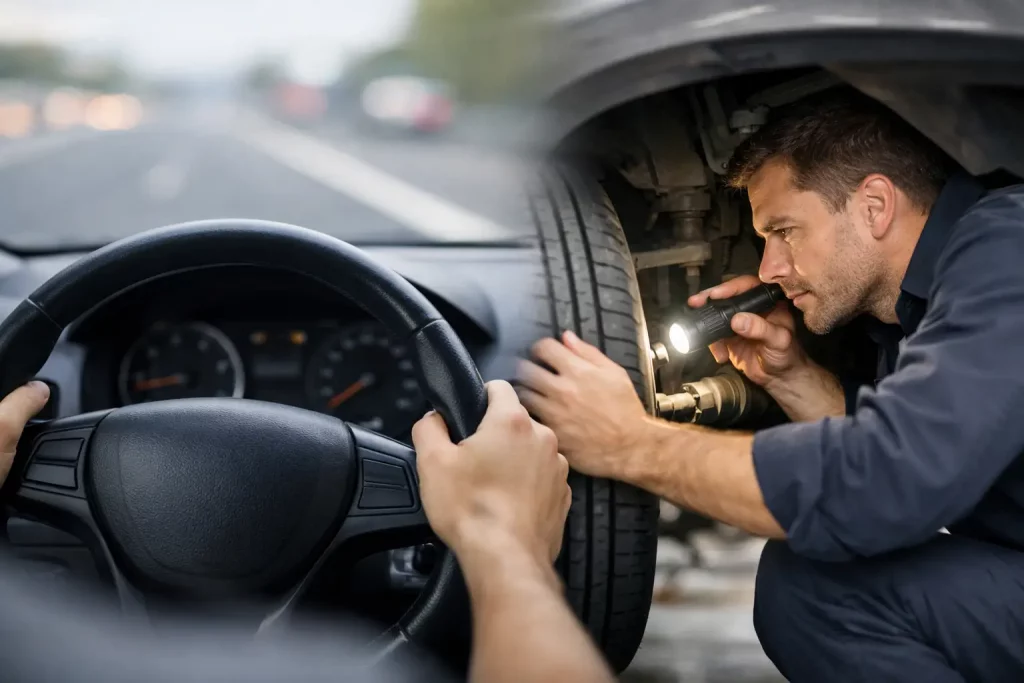
A car that needs small, repeated corrections to stay in lane can make even a familiar road feel uncertain. Steering wander is often described as vague, floating or nervous steering, but the feeling alone does not identify the failed part. To understand how to diagnose steering wander, the vehicle must be assessed as a complete system: tyres, wheel alignment, suspension geometry, steering linkage and, on modern vehicles, electronic steering assistance.
The distinction matters. Replacing a steering rack because the car wanders may not cure a tyre-related pull or a worn suspension bush. Equally, a basic alignment adjustment cannot compensate for play within the steering system. Accurate diagnosis prevents unnecessary replacement and helps return the vehicle to safe, smooth and precise control.
First, confirm that it is steering wander
Steering wander is not always the same as a vehicle pulling to one side. A pull is usually a more consistent tendency to drift left or right on a level road. Wander is less predictable: the vehicle may react to cambers, ruts, side winds or passing lorries more than expected, and the driver may need to keep correcting its direction.
A useful road-test description includes when the issue occurs. Does it appear at motorway speed, under braking, only on uneven roads or at all speeds? Is the steering wheel slow to return towards centre after a bend? Does the vehicle feel loose around the straight-ahead position, or does it respond sharply but then require another correction? These details help separate a steering fault from tyre, geometry or suspension concerns.
Road conditions can influence any vehicle, particularly those with wide tyres, lowered suspension or a performance-oriented alignment. The concern is excessive sensitivity compared with the vehicle’s normal behaviour, rather than every reaction to a poor road surface.
Start with tyres and wheel condition
Tyres are the first sensible check because they are the only components in contact with the road. Incorrect pressures can make a vehicle feel unstable, while a substantial difference in pressure across an axle can encourage drift or vague response. Pressures should be checked cold against the vehicle manufacturer’s specified settings for its load and wheel size.
Inspect tread wear across each tyre. Inner-edge or outer-edge wear can indicate an alignment or suspension issue, while irregular, scalloped or feathered wear may point to worn dampers, imbalance, alignment errors or repeated operation with a fault. Tyre age, sidewall damage, mismatched tyre types and poor-quality casings can also affect straight-line stability.
Wheel damage and excessive wheel run-out deserve attention too. A bent wheel does not always create obvious vibration, yet it can contribute to an unsettled steering feel. Before diagnosing more complex steering components, a workshop should establish that tyres and wheels are sound, correctly fitted and appropriate for the vehicle.
Check alignment, but do not treat it as the whole answer
Wheel alignment is a common cause of wander, but the relevant angles are more involved than simply setting the front toe. Toe affects the vehicle’s willingness to track straight and its turn-in response. Excessive toe-out can make steering feel nervous, while incorrect toe-in can reduce precision and accelerate tyre wear.
Caster and camber are equally significant. Caster helps the steering self-centre and promotes straight-line stability. A caster difference from side to side may cause a pull or inconsistent return to centre. Camber affects tyre contact and can influence how the car follows road cambers, especially where settings are outside specification.
A proper four-wheel alignment check is more valuable than an adjustment made only at the front. The rear axle thrust angle establishes the direction in which the vehicle is effectively travelling. If it is incorrect, the steering wheel may sit off-centre and the car can feel as though it is moving slightly sideways, even after front toe has been adjusted.
Alignment figures should also be interpreted, not merely printed. If a setting cannot be brought into specification, there may be a worn, bent or incorrectly fitted component. On modified, accident-repaired, classic or specialist vehicles, factory figures may need to be considered alongside the vehicle’s actual suspension specification and intended use.
How to diagnose steering wander through play checks
Once tyre condition and geometry have been assessed, the steering system needs a controlled inspection for free play. With the vehicle safely supported and the steering loaded appropriately, a technician can observe the relationship between steering-wheel movement and movement at the road wheels.
Play may be found in track rod ends, inner tie rods, steering-column universal joints, intermediate shafts, rack mountings or the steering rack itself. The important point is to locate where movement is being lost. A small amount of movement at the steering wheel can become a much larger delay at the tyres when several joints each have minor wear.
Rack mountings are sometimes overlooked. If the rack housing moves relative to the subframe as steering load changes, the driver may feel delayed response or a change in direction before the wheels settle. On vehicles with steering boxes, adjustment, internal wear and linkage condition require their own assessment. Over-tightening a steering box to disguise wear can create stiffness and poor self-centring, so it is not a shortcut to a correct repair.
Hydraulic racks can develop internal wear that is not visible from outside, while electric power steering systems may have mechanical play, sensor faults, motor concerns or calibration-related issues. Diagnostic trouble codes are useful evidence on EPS-equipped vehicles, but they must be considered with the mechanical inspection and the reported driving symptoms.
Do not overlook suspension and body mounting points
The front wheels cannot hold their intended alignment if the components locating them move under load. Worn wishbone bushes, ball joints, top mounts, anti-roll-bar links, dampers and subframe bushes can all affect directional stability. A vehicle may measure acceptably on an alignment ramp when stationary, then wander because a bush deflects during braking, acceleration or cornering.
Rear suspension condition matters as well. Rear axle bushes, control arms and wheel bearings can alter the car’s path and create a steering complaint that appears to come from the front. This is particularly relevant where a driver reports that the rear of the vehicle feels as though it is steering itself over uneven surfaces.
Corrosion, impact damage and previous repair work should be considered where appropriate. A distorted subframe, bent suspension arm or poorly positioned mounting point can make repeatable alignment difficult. In these cases, a new rack or a fresh set of tyres will not resolve the underlying geometry problem.
Assess steering assistance and calibration where fitted
Power assistance does not normally cause classic wander on its own, but it can change the way a fault is felt. Uneven assistance may make a driver over-correct, while an EPS warning light, inconsistent effort or failure to self-centre can indicate a need for electronic diagnosis alongside mechanical checks.
Many modern electric steering systems require steering-angle sensor calibration, torque-sensor learning or vehicle-specific coding after certain repairs. A replacement or reconditioned EPS rack may need to be correctly flashed, virginised where applicable, coded and calibrated before it can operate as intended. The exact procedure depends on the vehicle and its control systems, and dealer-level equipment may still be necessary for some models.
This is one reason a fault should not be diagnosed solely by replacing the most visible component. The steering rack may be serviceable, while the system needs calibration after alignment work or battery-related voltage issues. Conversely, a rack with measurable internal wear or an EPS electronic fault may require specialist repair, reconditioning or replacement.
Choose the repair after the cause is proven
The right repair follows the evidence. Worn external joints or suspension components may need replacement before alignment. A tyre concern may require a matched, roadworthy set rather than more steering work. Where a steering rack, box, column or shaft is confirmed as the source, component-level reconditioning can be a practical option for suitable units.
Pro Power Steering assesses suitable steering components individually, using appropriate OE or OE-quality parts where applicable and workshop testing completed units before dispatch. Not every unit is economically repairable or available for reconditioning, particularly where damage is extensive or electronic support is limited. In those cases, replacement and the correct coding, calibration and alignment procedure may be the more reliable route.
For garages and owners, the most useful job card is specific: the speed at which wander occurs, tyre findings, alignment readings, fault codes, measured play and any recent suspension or steering work. That information turns a vague complaint into a repair decision based on the vehicle in front of you.
A wandering car should not be accepted as a characteristic to live with. Have the cause traced methodically, then repair only what the inspection supports. The result should be more than a centred steering wheel: it should be a vehicle that tracks cleanly, responds predictably and gives the driver confidence on every journey.
