
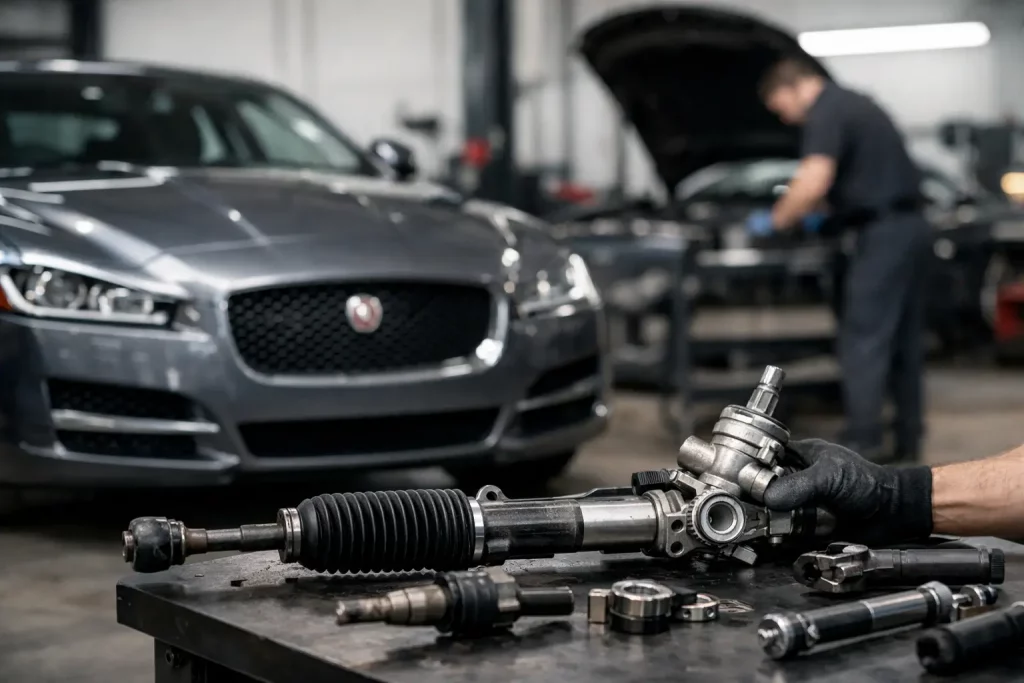
A Jaguar that no longer holds a clean line, feels unexpectedly heavy, knocks over broken surfaces or displays a steering warning needs more than a quick parts recommendation. A Jaguar steering overhaul starts with identifying exactly where steering precision has been lost. On many models, the rack, column, shafts, electronic assistance and vehicle software all play a part. Replacing the most obvious component without confirming the fault can leave the original problem unresolved.
For owners, workshops and restoration specialists, the objective is straightforward: return the vehicle to safe, smooth and predictable steering without replacing serviceable parts unnecessarily. The correct route may be component-level reconditioning, targeted repair, a tested replacement unit or, in some cases, a new complete assembly. It depends on the Jaguar model, its steering system, the fault present and the condition of the unit once inspected.
What a Jaguar steering overhaul can involve
The term overhaul is often used loosely. In specialist steering work, it should mean a structured assessment and repair process rather than simply fitting a replacement rack. The scope varies significantly between an older Jaguar with hydraulic assistance, a classic model with a steering box, and a modern vehicle with electric power steering.
A suitable steering rack may be stripped and inspected at component level. Wear in internal bushes, bearings, seals, rack bar surfaces, pinion components and adjustment areas can affect accuracy, effort and fluid retention. Where a unit is repairable, worn or damaged service items can be replaced with appropriate OE or OE-quality parts. The rebuilt assembly is then tested before it leaves the workshop.
On electric power steering systems, the mechanical rack is only part of the picture. An EPS fault may relate to the motor, torque sensing, internal electronics, wiring, power supply or stored fault information. A rack that is mechanically sound may still require specialist diagnostics and vehicle-specific coding after repair or replacement. Depending on the application, a compatible unit may need flashing or virginising before it can be coded and calibrated to the vehicle.
An overhaul can also include attention to related steering components where inspection identifies a clear issue. Columns, intermediate shafts and universal joints can contribute to stiffness, free play or an inconsistent steering feel. These parts should not be overlooked, particularly where the rack appears to operate correctly when assessed off the vehicle.
Diagnosing Jaguar steering faults before authorising work
Steering symptoms can overlap. A vehicle that wanders may have rack wear, but it could also have tyre condition, suspension wear or alignment angles outside specification. A heavy steering complaint can arise from a mechanical restriction, an assistance fault or a problem that only occurs at certain temperatures. This is why accurate diagnosis is the most valuable stage of the job.
A professional assessment should consider the driver’s report alongside physical checks and, on applicable models, diagnostic data. Useful observations include whether the fault is constant or intermittent, whether it changes after a journey, whether it is worse in one direction, and whether a warning message appears. A binding feel through part of the steering turn, for example, points towards a different investigation from a rack that leaks or has obvious free play.
For modern Jaguars, diagnostic trouble codes provide direction but are not a final diagnosis on their own. Low system voltage, damaged wiring, a communication fault or an incorrect configuration can all produce EPS-related warnings. Clearing a code without establishing why it was stored is rarely a dependable repair.
The vehicle’s history also matters. Collision damage, kerb impacts, water ingress, prior repairs and the use of an incorrect rack variant can alter the repair path. Right Hand Drive Jaguar steering assemblies are not always interchangeable with Left Hand Drive equivalents, even when external appearances are similar. Correct identification by vehicle details and part number is essential before a unit is supplied or reconditioned.
Common signs that need specialist attention
A steering overhaul may be worth considering when there is measurable play at the steering wheel, a clonk felt through the column, fluid loss from a hydraulic rack, uneven assistance, self-centring problems or an EPS warning accompanied by altered steering weight. Not every symptom means the rack has failed, but each deserves investigation before the vehicle is returned to regular use.
Drivers sometimes tolerate a gradual change because the car remains driveable. That is not always a sensible test of safety. Excessive free play, intermittent loss of assistance or a steering system that catches during operation should be assessed promptly, particularly on heavier Jaguars and performance models where precise control is central to how the vehicle behaves.
Reconditioning, replacement or repair: choosing the sensible route
A reconditioned steering unit can be a sound solution when the original component is suitable for rebuilding and the fault is contained within repairable areas. It can retain the correct vehicle-specific casing and configuration while addressing internal wear or leakage. Availability is also a practical advantage for older, specialist or difficult-to-source Jaguar applications.
However, reconditioning is not appropriate in every case. Severe corrosion, a damaged housing, an unusable rack bar, extensive electronic failure or previous unsuitable repairs may rule it out. Certain modern EPS assemblies may be technically repairable but still require additional vehicle-side checks, coding procedures or dealer-level support to complete the job correctly. A reputable specialist should be clear about those limits before work begins.
A replacement unit may be preferable where the original cannot be restored reliably, where a verified exchange unit is available, or where the vehicle manufacturer’s programming requirements make that route more appropriate. The lowest initial part price is not always the lowest overall cost if the replacement is incorrect, cannot be coded or has not been tested for the specific application.
For classic Jaguars, the decision may be slightly different. Originality, parts availability and the intended use of the car often influence the work. A steering box rebuild can preserve the vehicle’s original character, while some owners of suitable models may explore steering modifications designed to reduce effort. Any such work needs to retain predictable steering response and be chosen around the vehicle rather than treated as a universal upgrade.
Why coding, calibration and alignment matter
After steering rack work on many modern Jaguars, fitting the component is not the end of the repair. The vehicle may need its steering angle sensor checked or recalibrated, fault codes addressed, and EPS functions configured where required. If an EPS rack has been replaced or prepared for installation, the fitting garage must have the correct diagnostic capability and follow the applicable vehicle procedure.
Wheel alignment is equally important. Removing and refitting a rack changes the relationship between steering components, and even a small error in toe setting can affect straight-line stability, tyre wear and steering-wheel position. Alignment should be checked once the steering system is assembled correctly and any relevant calibration work has been completed.
There is a practical distinction here. Coding and calibration confirm that electronic systems understand the vehicle and steering position. Alignment confirms that the wheels point where the vehicle specification requires. One does not replace the other.
Working with a steering specialist
A steering repair is more dependable when the workshop and the steering remanufacturer exchange the right information from the start. Vehicle registration details, VIN where available, part numbers, diagnostic codes, photographs of the unit and a clear description of symptoms all help avoid delays and incorrect component selection.
For supply-only work, the fitting garage should confirm whether coding, calibration and alignment are required before the vehicle is dismantled. For a component sent away for assessment, protecting the unit during transport and retaining associated identifiers helps the specialist verify its application. UK-wide collection and delivery can be useful for suitable steering components, particularly where a Jaguar is off the road awaiting a hard-to-source repair.
Pro Power Steering approaches suitable Jaguar units as specialist engineering work: diagnose the fault, assess whether component-level reconditioning is viable, test completed work and provide direct technical support where it is needed. Completed repairs are supported by a 12-month warranty under the applicable terms, but the quality of installation and correct vehicle-side procedures remain essential to the final result.
If your Jaguar’s steering has changed in feel or behaviour, record when it happens and arrange a proper assessment before ordering parts. A clear diagnosis gives the best chance of restoring the precise, confidence-inspiring steering the vehicle was designed to deliver.
