
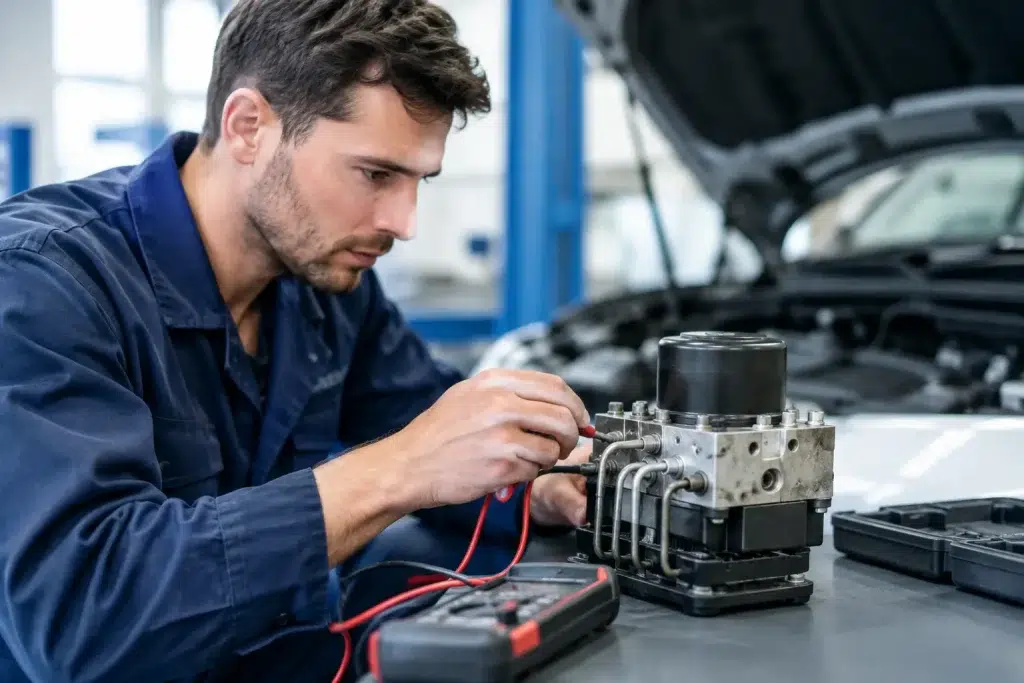
Electric power steering can appear to fail without much warning: a red steering wheel warning lamp, intermittent loss of assistance, a heavy wheel at parking speed or steering that feels inconsistent from one lock to the other. Understanding why EPS fails starts with recognising that the system is not one component. It is a network of mechanical parts, sensors, control electronics, wiring and vehicle data systems, all of which must agree before the car can provide safe, predictable assistance.
For that reason, a fault code pointing to the steering rack or column is a useful starting point, not necessarily a verdict that the complete unit needs replacing. Accurate EPS diagnosis separates a failed component from a power supply, communication, coding or calibration issue that is affecting an otherwise serviceable steering system.
Why EPS Fails: The Main Causes
EPS systems use an electric motor to provide steering assistance instead of relying solely on hydraulic pressure. Depending on the vehicle, the motor may be fitted to the steering column, pinion or rack. A control unit uses inputs from sensors, including torque and steering angle sensors, then adjusts motor assistance according to vehicle speed and steering demand.
This makes EPS efficient and adaptable, but it also means a fault anywhere in the chain can alter the way the steering feels. The most common causes fall into four areas: electrical supply and wiring faults, sensor or electronic control faults, motor and internal rack faults, and mechanical problems that overload or restrict the system.
Voltage and power supply problems
EPS motors can draw substantial current, particularly during low-speed manoeuvring. A weak battery, poor charging performance, voltage drop through a main feed, damaged earth connection or corroded connector can therefore trigger a steering warning lamp or cause assistance to reduce.
Some vehicles will store low-voltage or supply-related fault codes after a flat battery, jump start or charging issue. Others may limit assistance as a protective measure. Before condemning a rack or column, the system should be checked under load, not simply measured with the ignition switched on. Battery condition, alternator output, fuses, high-current feeds and earth points all matter.
Water ingress and damaged wiring
Steering racks live in a harsh environment beneath the vehicle. Road spray, salt, damaged undertrays, blocked drainage paths and split gaiters can allow moisture to reach connectors, wiring or electronic sections of a rack. Vehicles that have suffered accident damage or previous poor repairs may also have strained, trapped or incorrectly routed wiring.
Water ingress does not always cause an immediate, permanent fault. It can create intermittent warnings, especially in wet weather, before corrosion progresses and communication or motor-control faults become consistent. A visual inspection is valuable, but diagnosis should also include connector condition, wiring continuity, power and earth integrity, and network communication checks where relevant.
Torque sensor and position sensor faults
The torque sensor tells the EPS control unit how much assistance the driver is requesting. If its signals are implausible, out of range or do not correlate correctly, the control unit may disable or restrict assistance. Depending on the design, this sensor may be integrated into the column, pinion assembly or steering rack.
Steering angle and position information can also be critical. Modern vehicles share data between steering, stability control, braking and driver-assistance systems. A steering angle sensor that has lost its reference position, or a system that has not been calibrated after repair or alignment work, may produce warning lights and unusual steering behaviour even where the mechanical steering is sound.
Electric motor and control electronics failure
The EPS motor, reduction gear and control electronics work hard in stop-start driving and frequent low-speed steering. Internal wear, thermal stress, failed solder joints, damaged circuit boards or motor-related faults can cause assistance to become noisy, uneven or unavailable.
Heat is relevant here. Many EPS systems reduce assistance temporarily if the control unit detects excessive temperature during repeated parking manoeuvres or sustained high steering demand. If assistance returns once the system has cooled, that may be a protection strategy rather than proof of a permanent failure. Repeated overheating, however, requires investigation into the unit, its electrical supply and any mechanical resistance in the steering system.
Mechanical Resistance Can Look Like an EPS Fault
Not every heavy steering complaint is caused by failed electronics. A stiff universal joint, seized suspension component, damaged top mount, incorrect geometry or internal rack wear can increase the force needed to turn the wheels. The EPS system may then appear weak because it is being asked to overcome abnormal resistance.
Internal rack issues can produce tight spots, inconsistent self-centring, knocking or a steering wheel that feels reluctant through part of its travel. Excessive play may point to wear in the rack, inner joints or related steering components. These faults need careful assessment because fitting an electronic replacement without correcting the mechanical cause can leave the original symptom unchanged.
Wheel alignment is also part of the wider picture. Incorrect toe or a steering wheel that is not centred can affect handling and may prevent successful steering angle calibration. Alignment alone will not cure an electrical EPS fault, but it is often essential after rack removal, subframe work or replacement of steering and suspension components.
Symptoms That Need Specialist Assessment
A steering warning lamp should not be ignored, even if assistance returns after restarting the vehicle. Intermittent EPS faults can become permanent, and a vehicle with reduced assistance can be difficult to control safely at low speed.
The exact symptom helps guide diagnosis. Complete loss of assistance often directs attention to supply, communication, control unit or motor faults. Assistance that comes and goes may suggest voltage drop, wiring damage, water ingress or heat-related protection. A notchy or uneven feel may have a mechanical origin, while a wheel that is off-centre or warning lights appearing after repair may indicate a calibration requirement.
Diagnostic trouble codes, live data and vehicle history should be considered together. A code for a torque sensor or motor circuit does not automatically prove that the sensor or motor is defective. The technician needs to establish whether the reported fault is current, stored or intermittent, then test the conditions that caused it.
The Proper Diagnosis Process for EPS Faults
A dependable assessment begins with the vehicle-specific fault report and a discussion of when the problem occurs. Does the warning lamp appear on start-up, after driving in rain, during parking, following battery replacement or after accident repairs? This context can prevent expensive guesswork.
The next stage is to inspect the steering system and associated electrical connections, then test battery condition, charging voltage, relevant feeds and earths. Diagnostic equipment is used to read fault codes, assess live data and check communication between modules. On suitable systems, comparison of torque sensor values, steering angle data, motor demand and supply voltage can reveal whether the fault lies within the EPS assembly or outside it.
Mechanical condition must be checked alongside electronics. The rack should move smoothly, related steering joints should not bind, and suspension or geometry problems should be identified before a repair decision is made. Where a rack or column has been removed or replaced, coding, initialisation and steering angle calibration may be required before the vehicle is returned to service.
Repair, Reconditioning or Replacement?
The correct option depends on the vehicle, the exact failure and the condition of the unit. Some steering racks and columns are suitable for component-level reconditioning, where worn or failed internal parts can be addressed and the completed unit tested before dispatch. This can be a practical alternative to replacing a complete assembly when the application and damage allow it.
However, not every EPS unit is economically repairable or appropriate for reconditioning. Severe corrosion, extensive water damage, unavailable electronic components or a damaged housing can make replacement the safer route. Certain vehicles may also require a new or manufacturer-authorised unit because of security, software or parts availability restrictions.
For applicable EPS racks, a repaired or reconditioned unit may need flashing or virginising before vehicle-specific coding. The fitting garage may then need suitable diagnostic equipment to complete commissioning and calibration. These requirements should be confirmed before work begins, particularly on premium and late-model vehicles where module configuration can be closely tied to the vehicle.
Pro Power Steering assesses suitable units at component level and can provide direct technical guidance to owners and fitting garages on repair suitability, fitting requirements and the likely need for coding or alignment. Completed applicable work is workshop tested and supported by a 12-month warranty under the relevant terms.
Avoiding the Wrong Repair Decision
The costliest EPS repair is often the one based solely on a warning lamp or a single stored code. Replacing a rack when the cause is low system voltage, a poor earth or an uncalibrated steering angle sensor does not restore confidence in the vehicle. Equally, treating a genuine internal rack fault as a simple coding issue can delay a necessary repair.
A proper diagnosis gives owners and workshops a clear route forward: repair the component where appropriate, rectify the external cause where identified, or choose replacement when that is the sound technical decision. When steering assistance changes, the priority is not merely clearing the warning lamp. It is restoring smooth, precise steering with the correct electrical, mechanical and calibration checks behind it.
