
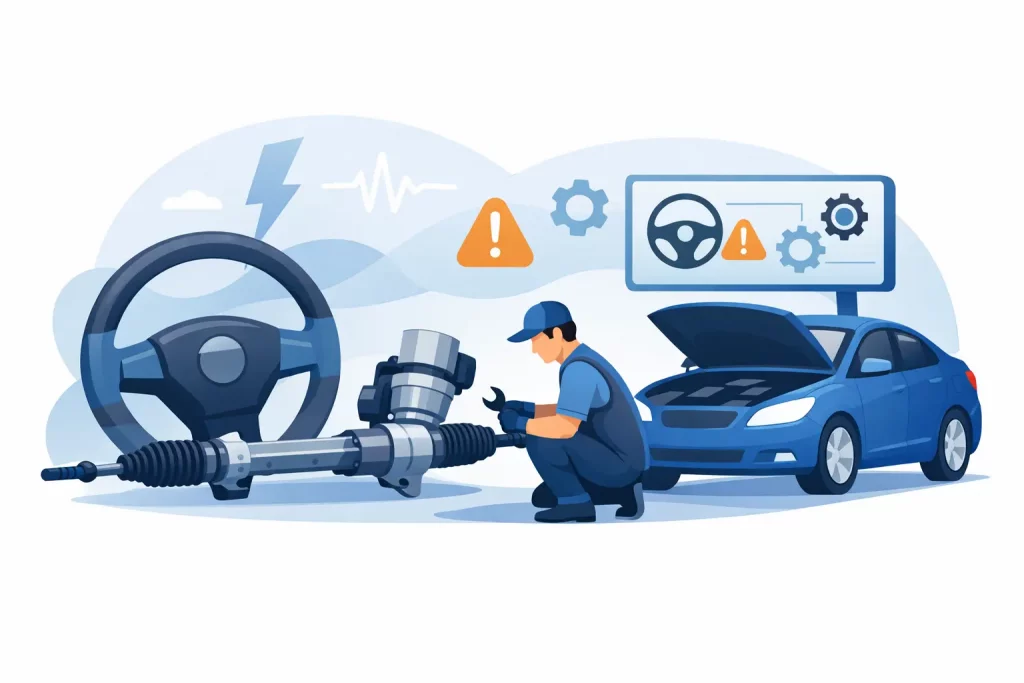
A steering warning light, sudden heaviness at parking speed or a steering wheel that feels inconsistent are not faults to leave until the next service. Electric power steering repair starts with identifying precisely why assistance has changed. On many modern vehicles, the fault may lie in the motor, control module, torque sensor, wiring, battery supply or the steering rack itself. Replacing the complete rack before those checks are made can turn a repairable fault into an unnecessarily expensive job.
Electric power steering, usually referred to as EPS, has become standard across a huge range of passenger cars, vans and performance vehicles. It reduces engine drag, allows variable assistance at different speeds and supports driver-assistance features. It also means the steering system depends on mechanical condition, accurate sensor readings and stable electrical power. A proper diagnosis must consider all three.
How an electric power steering system works
Unlike a hydraulic steering system, EPS does not use a belt-driven pump, fluid reservoir or high-pressure hoses to provide assistance. An electric motor supplies the additional turning force. Depending on the vehicle, that motor may be fitted to the steering column, the pinion housing or directly to the steering rack.
When the driver turns the wheel, a torque sensor measures the steering input. The EPS control unit combines that reading with data such as vehicle speed, steering angle and motor position, then commands the motor to provide the required level of assistance. Light steering at low speed and firmer steering on faster roads are therefore deliberate system characteristics, not separate mechanical settings.
The arrangement is efficient, but it is also sensitive to faults outside the steering assembly. A weak battery, poor earth connection, damaged wiring loom or low charging voltage can all trigger an EPS warning light or cause assistance to reduce. That is why fault-code reading alone is not enough. It gives a direction for testing, rather than a final repair decision.
Signs that EPS repair may be needed
Loss of assistance is the most obvious symptom. The wheel may become markedly heavier, especially when manoeuvring, although the vehicle can usually still be steered mechanically. It will require more effort, and driving should be kept to a minimum until the cause has been assessed.
Some faults are less dramatic. Assistance may come and go, feel uneven from lock to lock or change after the vehicle has warmed up. Drivers may notice a notch, tight spot or delayed response near the straight-ahead position. A clicking, knocking or graunching noise when turning can point to internal rack wear, a motor drive fault, worn column joints or an unrelated suspension component.
An EPS warning symbol on the dashboard is a clear reason to arrange diagnostics, but the absence of a warning does not prove the system is healthy. Mechanical play in the rack, track rods or steering column can affect accuracy without setting a stored electrical code. Likewise, incorrect wheel alignment can make a sound steering system feel unstable or reluctant to self-centre.
Accurate diagnostics before electric power steering repair
A specialist inspection should begin with the basics. Battery condition, charging voltage, main fuses, earth points and connector condition need checking before the steering unit is condemned. Modern EPS systems can be voltage-sensitive, and a temporary low-voltage event can leave a fault stored in the control module even where the rack itself is serviceable.
Vehicle-specific diagnostic equipment is then used to read fault codes and live data. Useful readings include supply voltage, requested and actual motor torque, torque-sensor values, steering angle, motor position and communication status with other control units. The technician should consider whether readings change smoothly as the wheel is turned, whether the values agree with one another and whether the fault is permanent or intermittent.
A physical inspection remains essential. The rack must be checked for free movement, damaged gaiters, corrosion, impact damage and play at the inner joints. The steering column, universal joints and intermediate shaft should also be assessed. A stiff universal joint can imitate a rack fault; replacing the rack would not cure it.
Road testing can help reproduce an intermittent concern, but it should be carried out only when steering control is safe. The aim is to establish the conditions under which the problem occurs: cold or hot, at full lock, after hitting a bump, during parking, or only after a warning light appears. That evidence helps separate an electrical connection issue from an internal component failure.
Common EPS faults
Electric motors can suffer from worn brushes on older designs, damaged bearings, internal corrosion or overheating. A motor may work when cold and cut out as resistance rises with temperature. In rack-mounted systems, water ingress through damaged seals or gaiters can affect the motor and electronics as well as the mechanical rack assembly.
Torque sensors are another common cause of irregular assistance. If the control unit cannot accurately determine the driver’s steering input, it may reduce assistance or log a plausibility fault. Some sensors are integral to the rack or column assembly, while others can be repaired or replaced at component level depending on the design.
Control module faults can result from age, heat, moisture or electrical spikes. However, not every module code means the module has failed. Communication errors may originate from a wiring issue, a poor power supply or a fault elsewhere on the vehicle network. Careful testing prevents an expensive and incorrect replacement.
Mechanical wear should not be overlooked simply because the vehicle has EPS. Worn rack guides, pinion bearings, inner joints and track rod ends can produce knocking, wandering or excess free play. These faults affect safety and tyre wear whether or not electrical assistance is operating normally.
Repair, reconditioning or replacement?
The right option depends on the fault, vehicle age, parts availability and the condition of the complete assembly. A damaged connector, failed external wiring section or calibration issue may be resolved without removing the rack. Where the motor, sensor or internal electronics are repairable, component-level electric power steering repair can offer a more cost-effective route than fitting a new dealer unit.
Reconditioning is particularly valuable where a rack has both mechanical wear and an EPS-related fault. A properly reconditioned unit is stripped, cleaned and inspected, with worn or defective serviceable components replaced. It must then be rebuilt to specification and tested before fitting. The quality of this process matters more than the label on the box. A low-cost used rack may carry the same age-related fault, water damage or internal wear as the one removed from the vehicle.
There are situations where replacement is the sensible route. Severe crash damage, cracked housings, unavailable electronic components or extensive corrosion can make repair impractical. New units may also be the preferred choice for certain late-model systems where coding restrictions or parts availability limit reconditioning. A specialist should explain the reasoning, rather than treating replacement as the automatic answer.
For garages and fleet operators, a tested reconditioned exchange unit can reduce vehicle downtime. For owners of classic, sports or lower-volume vehicles, repair of the original unit may be preferable where replacements are scarce or where retaining the correct vehicle-specific assembly matters.
Coding, calibration and fitting are part of the job
Fitting an EPS rack or column is not simply a mechanical swap. The steering wheel must be centred, the rack installed in its centre position and all fixings tightened to the manufacturer specification. The intermediate shaft connection is safety-critical and must be fitted correctly.
Many vehicles require coding, commissioning or parameterisation after a replacement rack, motor or module has been installed. Steering-angle sensor calibration may also be required, particularly where stability control, lane-assistance or parking systems use steering data. If this step is missed, warning lights may remain on, assistance may behave incorrectly or driver-assistance systems may be unavailable.
Wheel alignment should be checked after rack removal or adjustment of steering components. A vehicle that pulls, has an off-centre steering wheel or wears tyres unevenly will never feel precise, even with a fully functioning EPS system. Correct alignment completes the repair and protects the new or reconditioned components.
When to stop driving
If steering suddenly becomes heavy, the EPS warning light is accompanied by other electrical warnings, or there is obvious free play or a knocking noise, arrange inspection promptly. Avoid continuing to drive if steering response feels unpredictable, the wheel sticks, or there is any concern about safe control.
Do not assume that switching the ignition off and on has fixed the issue simply because assistance returns. Intermittent faults often recur under the same heat, voltage or vibration conditions. Recording when the warning appeared and what the vehicle was doing can give the technician useful diagnostic information.
Pro Power Steering approaches EPS faults as a steering-system problem, not a parts-selling exercise. That means examining the electrical supply, diagnostic data and mechanical assembly before advising on repair, reconditioning, supply and fit, or replacement. Completed work is supported by a 12-month guarantee, giving owners and trade customers confidence in the repair route chosen.
A steering system should feel smooth, consistent and accurate every time the vehicle is used. When it does not, early specialist diagnosis usually gives the best chance of preserving the original components, controlling cost and restoring the confidence that precise steering is meant to provide.
